Category Archives: Pets/Animals

Legislation Helps Protect Domestic Violence Victims and Their Pets

Dogs and Cats in a RowU.S. Senators Gary Peters (D-MI) and Kelly Ayotte (R-NH) today introduced the Pet and Women Safety (PAWS) Act, to protect victims of domestic violence, sexual assault, stalking and dating violence from emotional and psychological trauma caused by acts or threats of violence against their pets. Multiple studies have shown that domestic abusers often seek to manipulate or intimidate their victims by threatening or harming their pets.

“Pets are treasured members of our families, and victims of domestic violence can often get caught in a cycle of abuse because they cannot take their pets with them when they try to leave their abusers,” said Senator Peters. “This legislation provides important support to better empower victims of domestic violence to leave abusive situations, recover the cost of veterinary bills if an abuser harms their pet, and find shelter and housing that allows them to keep their pets as companions.”

“Domestic violence victims should not have to choose between their own personal safety and that of their pet,” said Senator Ayotte. “Domestic violence is about power and control, and all too often we see abusers harming or threatening to harm pets in an attempt to exercise control over their victims. The PAWS Act provides important authorities and resources to help empower victims of domestic and sexual violence and stalking to leave abusive situations and seek help.”

The PAWS Act would amend the federal criminal code to prohibit threats or acts of violence against a person’s pet under the offenses of stalking and interstate violation of a protection order. The bill also requires the full amount of the victim’s losses for purposes of restitution in domestic violence and stalking offenses to include any costs incurred for veterinary services relating to physical care for the victim’s pet. The legislation further directs the Department of Agriculture to award grants to eligible entities to carry out programs to provide specified housing assistance, support services, and training of relevant stakeholders to victims of domestic violence, dating violence, sexual assault, or stalking and their pets.

“No one should have to make the impossible choice between leaving an abusive situation or protecting their pet,” said Nancy Perry, senior vice president of American Society for the Prevention of Cruelty to Animals (ASPCA) Government Relations. “Studies demonstrate that abusers often intentionally target pets to exert control over their partners, and as many as 25 percent of domestic violence survivors have reported returning to an abusive partner out of concern for the safety of their animal. The federal protections offered by the PAWS Act will provide valuable resources to give victims and their pets the security they need to escape a dangerous environment, which is why the ASPCA is grateful to Senators Ayotte and Peters for introducing this legislation.”

“Many states allow pets to be included in restraining orders, but what happens when a domestic violence victim must go live with family in another state where pets are not covered?” said Michael Markarian, chief program and policy officer for The Humane Society of the United States. “We must have a national policy that safeguards the pets of abuse victims, and recognizes that domestic violence impacts all members of the family—including the four-legged. We are grateful to Senator Peters for working to provide victims and their families with the help they need.”

The ASPCA reported that a study in Wisconsin found that “68% of battered women revealed that abusive partners had also been violent toward pets or livestock; more than three-quarters of these cases occurred in the presence of women and/or children to intimidate or control them.” Moreover, a 2014 New York Police Department study found that 71 percent of pet-owning women entering domestic violence shelters reported that their abusers threatened, harmed or killed family pets. Yet, only a small number of domestic violence shelters permit pets.

The PAWS Act has been endorsed by the Humane Society, National Sheriff’s Association, the National Network to End Domestic Violence, the American Veterinary Medical Association, the American Society for the Prevention of Cruelty to Animals, the Animal Legal Defense Fund, and the National Coalition Against Domestic Violence.

Who Let’s the Dog Out?

meghan_dooley

Jenn Gavin has many ideas to keep your dog active

They say a dog is a man’s best friend. A loyal companion until the end.

But, in a day and age where everyone is constantly on the go, taking care of your pup has taken on a new meaning.

Dog trainer Jenn Gavin, owner of A Pleasant Dog Dog Training service, says being busy is not only a challenge for owners, but it can also cause frustration for your pet. “Some people think that having your dog out in the yard for playtime is sufficient exercise for them and it’s really not,” Gavin explains.

This doesn’t mean it’s the end of the road for city dog owners, Gavin says there are many solutions to engage in activities that are enjoyable for both you and your dog.

Dog“There are also games you can play, fetch is a fun one,” Gavin said, “Hide and go seek is an easy one to teach.”

But even if an owner can exercise Fido after work ours, it can still be difficult to attend to the dog during the workday.

So, if you do have to cage your dog you can use toys like a stuffed Kong filled with peanut butter or a small ball to keep their minds busy while you’re away.

However, if you cannot make it home, Gavin says you can seek the help of a dog walking service.

Dog walking husband and wife duo Jackie and Luke Moord, owners of Nature of the Dog, try to help out working folks as much as possible.

Jackie and Luke Moord walk dogs to help the business professionals

“We cater to the business professional,” Jackie said. “And they’re normally too tired to walk their dog at the end of the day.”

They even try to educate their customers about the needs of catering to having a dog in the city. “It’s about being competent dog handlers,” Luke explains.

Overall, Gavin says while some dogs vary in the types of lifestyles they need-with the right mental and physical stimulation any dog will be just fine. According to Gavin, “A good dog is a tired dog.”

Trash Bag Tabby

michele_smith-aversaWe’ve all seen plastic garbage bags on the shoulder of the road and in ditches.  We ignore them because we assume they contain someone’s garbage, right?


Not always.

A Gruesome Discovery

The Saturday before Thanksgiving, Pat*, a longtime Cedar Springs resident, walked out to her mailbox as she does each day.  But this day was different.  She noticed a garbage bag in the ditch by the edge of the road.  Initially irritated that someone had treated her property as their personal garbage dump, she walked over to the bag.  But there was something odd about this particular bag.  Pat saw that while the top was securely tied, the bottom of the bag was shredded and partially open.  When she took an even closer look, she was sickened to see that inside the garbage bag was the body of a brown tabby cat.   It must have shredded the bottom of the bag trying to escape its plastic prison.  Pat reached down toward the cat and made a truly gruesome discovery: the cat was still alive.

Once left for dead in a plastic bag in a ditch, Mister (kitty) is healthy and needing a home.


Somebody had literally thrown away a live animal!


At this point, there was no telling how much damage the cat had sustained after being tossed into a ditch and then left to freeze in the unseasonably cold weather. From its condition, Pat assumed the cat was dying. It was not moving, showed no sign of having any energy and when it looked at her to meow, scarcely a sound came out.


Worried for its health, she scooped up the cat, bag and all, and brought both into her house.  Pat wrapped the cat in a blanket and held it, consoling the tabby while it was shivering with cold and fear. She then set up a pet carrier with blankets, leaving the door open. Next to that, she set out  food and water.  After several hours, the cat was able to walk over and drink the water.  “He was surprisingly thirsty,” Pat says.


She left him alone for a while to eat and rest, checking on him periodically.  The victimized animal sprang back quickly.  Pat guessed that the cat could not have been in the bag in the ditch longer than 24 hours. “I know that bag wasn’t there when I got the mail on Friday but it was there on Saturday.”  Luckily for the brown tabby, Pat did not ignore someone else’s “trash.”


Two days after finding it, Pat, spent money out of her own pocket and took the cat to the Sparta Animal Hospital for a checkup, “…because you gotta do the right thing,” she explained.  She was surprised that even after his ordeal, he went into the carrier easily.  She was more relieved when the vet reported that the tabby was a neutered male, only around a year old and was in good condition.  Fortunately, Mister (as Pat later named him) there were no broken bones or other injuries.


“Who does that?” Pat’s brow furrows in anger now.  “Who raises an animal, spends the time and money to neuter it and then does something awful like this?”


After spending a few more days together following the vet visit, Pat says Mister allowed her to get close and pet him, adding, “Once he knew I wasn’t going to hurt him.”


Over the holidays, Pat had many visitors which included her grandchildren.  Mister welcomed them, neither fearful nor annoyed.  Being such a friendly and gentle cat, Pat is still puzzled why someone wouldn’t want him – to the point they would go to such ghastly lengths to get rid of him.


Sadly for Mister, Pat’s four dogs refuse to accept him into the family.  Mister tries to play with the canine crew, but they don’t want to play with Mister.

Mister is a nuetered male tabby about a year old.


Thus, Pat began her search for someone that could take him.  Two of Pat’s friends had recently adopted their cats from Focus on Ferals Cat Shelter and Adoption Center in Byron Center MI.   Founder Gina Marvin immediately agreed to take Mister into the adoption program, where he currently resides.


Says Marvin, “Tragically for animals, we still live in a society where people think it is a good idea to literally toss them out like trash. Only God knows how many are never found. The lucky ones get rescued by some kind-hearted person who just happens upon them. It goes without saying that the discarded animals deserve to be rescued. But also, those everyday people like Pat, who do not have resources to place an animal, and who still go out of their way to save an animal, deserve to get help.”


Like Marvin, Pat is no stranger to rescuing animals.  Back in 1979, she recalls stopping a man in a pickup truck from deliberately driving over a snapping turtle.  And she has been protecting animals ever since.  From “traveling cats” who stop by her property from time to time, to litters of unwanted kittens that get dropped off in her barn, she spends money out of her own pocket to ensure that they have veterinary care, are fixed and stay safe.


“Because you gotta do the right thing.”


If you are interested in Mister, or any of the other cats in the Focus on Ferals adoption program, or would like to make a donation on behalf of one of the cats, visit www.focusonferals.org.


*Pat wants to share her story for the sake of all victimized animals, but prefers to remain an anonymous hero.

The K-9 Unit is an Officer’s Best Friend

Former and current members of the K-9 Unit. (Left to right: Sergeant Jeff Bylsma,
Former and current members of the K-9 Unit. (left to right: Sergeant Jeff Bylsma, Kresten Green, Bob Robinson, and Eric Toonstra)

mike_dewittImagine a job where your work partner was around all day, every day. Punching out after a shift just meant you had to drive them home, to your house, to eat your food!


Now, imagine that partner with four legs, a beautiful fur coat, and a sense of smell 10,000 times better than yours. Welcome to the Wyoming Police K-9 Unit, a position that understands the importance of a dog being a man’s best friend.


What is the K-9 Unit?


The Wyoming K-9 Unit is a division within the Wyoming Police Department where officers are paired with dogs for a 10 year stint. The dogs do everything with the police officers they’re partnered with. They train together, work together, and come home under the same roof.


They are not only partners on the job, but they’re family on and off the clock.


How does an officer get involved with the K-9 Unit? Is prior dog handling experience necessary?


No prior dog handling experience is needed to handle the dog. However, that doesn’t mean anyone off the street can apply to be a member of the unit. The K-9 Unit is hired from within the Wyoming Police Department. If you’re not already a member of the police force, you won’ be considered.


Even though it’s a big commitment to work with a dog 24 hours a day, the positions aren’t difficult to fill when they open up. There are officers always willing to be dog handlers. It’s a unique experience and lifelong friendships are created with the dogs.


You keep saying ‘dogs’, what kind of dogs are we talking about here?

Bob Robinson and his dog of 10 years Arras.


German Shepards are the dogs of choice within the K-9 Unit. As a dog, the German Shepard has the best package of skills necessary to be an exceptional police dog. They’re smart, agile, personable, and have a keen sense of smell good for tracking scents and sniffing out narcotics. German Shepards can also be trained to bite if they have to!


Bombs and narcotics!? That seems like a lot for one dog to handle. How do you know whether the dog has sniffed out a drug or a bomb?


The dogs are either trained for one or the other, never both. If a dog is trained to sniff out both, than the officer has no idea what to expect! Because of that reason, dogs are specialized on what to look for. Some dogs are brought in for bomb detection while others are brought in for drug identification.


Is that all these dogs are used for, drugs and bombs?


No, the dogs are used whenever their superior sense of smell and tracking abilities are needed. The dogs respond to burglaries, search for the elderly that are wandering about, kids that are lost, and situations where suicidal people are out in the woods and need help.

https://www.youtube.com/watch?v=dU6NvSULuOU&feature=youtu.be

Which season works best for tracking and which season is the most difficult?


It’s easiest for the dogs to track in the summer and most difficult in the winter. However, the winter snow usually leaves footprints behind, and that makes things more manageable!


Where does the Police Department get these highly specialized dogs?

Eric Toonstra and his Dutch Shepard named 'Dutch'
Eric Toonstra and his Dutch Shepard named ‘Dutch’

There is a facility down in Indiana the Wyoming Police Department likes to use to find their new dogs. It’s close in proximity and gives the department the flexibility to choose between 30 different dogs. Some of the dogs are even imported from Europe.


Hold on a quick second, they import dogs from Europe? Why would they need to do that? What’s wrong with dogs bred here in America?


It’s not that there’s anything ‘wrong’ with American bred dogs, it’s more the way in which dogs are bred in Europe as opposed to in America. In America, dogs are bred for beauty and purity. A negative side effect of breeding dogs for purity are health problems earlier in life. If a dog has bad hips after two years on the job, they aren’t a very effective or reasonable choice as a police dog.


European dogs are bred differently, they’re stronger because they’re bred for sport. It’s more important for the dog to be healthy and athletic than it is for the dog to look ‘pure’. If they’re going to be a member of the police force, the dogs need to be reliable for an extended period of time. These dogs are expensive, and even though they’re great pets and friends, they have a job to.

Kreston Green and his dog Azar


Speaking of cost, how much are these dogs and how are they paid for?


The dogs are expensive, the newest addition to the team, a full German Shepard from Slovakia named Azar, cost $6,300. The department puts on a 5K the first week in October to help raise funds and awareness for the K-9 Unit. The 5K this year raised enough money to buy Azar.


That’s one expensive puppy! What do they feed the dogs to keep them work ready?


Meals consist of high energy foods. High protein and high carbs are a must! The most important rule, NO PEOPLE FOOD! If a dog is used on a house raid, and there’s food out in the open, it becomes a problem if the dog’s first instinct is to go to the food. It not only makes the job more difficult for everyone involved, but it could be detrimental to the dogs health if they eat something they’re not supposed to.


Something I still haven’t quite figured out, how do the dogs ride to work with their officer? Do they just hangout in the back seat of the cruiser?

IMG_0078
The backseat of the K-9 Cruiser


Well, kind of! Although, the cruisers are specially built to accommodate the dogs. There is a special place for them where they can lay down with food and water readily available. The cruisers designed for the K-9 unit are used specifically for the purpose of accommodating the dogs.


How would you describe the dog’s relationship with their handlers?


It’s a very positive relationship in both directions. The dogs get excited when they alert about a find because they are consistently given positive reinforcement. The dogs all have a favorite chew toy or ball that they are given to play with when they do complete their job. They live to please their handlers.


The officers see their dogs not only as partners, but as family. The job is different everyday and it’s impossible to get bored.


The dogs all have their own personalities and quirks. They have good days and bad days, but at the end of the day, they’re a team!


What happens to the dogs after their service is completed?


After the dogs and their handler completes their 10 years of service together, the officer gets the reward of taking the retired dog home, to live life as a pet and a member of the family.

WKTV would like to thank the K-9 Unit for spending time with us!

Got a Buck save a Duck

For ever plate bought, $25 goes to Ducks Unlimited
For every plate bought, $25 goes to Ducks Unlimited

Secretary of State Ruth Johnson is encouraging motorists to purchase the new Ducks Unlimited fundraising plate, adding that the revenue generated from the sales will profit more than just ducks.


“The new Ducks Unlimited license plate supports conservation and outreach activities that highlight the importance of wetlands,” Johnson said. “Wetlands are essential not only to waterfowl but to the millions of Michigan residents who depend on them for clean drinking water, recreation and more.”


Motorists purchasing a Ducks Unlimited plate will pay $35 in addition to any regular registration fees that are due; $25 of the $35 will go to Ducks Unlimited. When the plate is renewed, an additional $10 is collected and sent to the cause. The Ducks Unlimited plates may also be personalized for a fee, giving motorists another opportunity to showcase their support.

Secretary of State Ruth Johnson promotes new Ducks Unlimited plate as beneficial to entire state


“We’re really pleased to see the license plates available for sale,” said Pete Albrecht, state chair of Michigan Ducks Unlimited. “Michiganders have real pride in their waterfowl heritage and the habitat in which waterfowl flourish. This is another way to express that pride and put money back into Michigan wetland habitat conservation at the same time.”


The Ducks Unlimited plates went on sale last month. Plates may be purchased at any Secretary of State office, or by mail using the online fillable form on the Secretary of State website.


Michigan’s marshes and wetlands provide food and shelter to hundreds of species of ducks, geese and swans. Wetlands play an important role for waterfowl, but they also are beneficial to humans by reducing floods, filtering pollutants out of the water, recharging underground water supplies, and providing great commercial and recreational value to the economy.


Ducks Unlimited Inc. is the world’s largest nonprofit organization dedicated to conserving North America’s waterfowl habitats. Established in 1937, Ducks Unlimited has conserved more than 13 million acres thanks to contributions from more than a million supporters across the continent. Visit its website at www.ducks.org for more information.

15 Creative Cat ‘Toys’ That Won’t Bust Your Budget


Pet stores are full of fantastic cat toys – i.e. laser light, plastic ball, crinkle sacks (has anyone’s cat ever used one??) 400 versions of a mouse – squishy, squeaky, cat nip filled, fabric covered, fur covered, flannel covered, flat, fat, fluffy, fuzzy, stripes, polka dotted, pink, yellow, green, brown, black, white, makes crinkle noise, runs on wheels, battery operated, remote controlled, blinking lights in their butt, and the list goes on and on.

The smaller toys are only $4 – $5 dollars. Easily justifiable, right? We run into the store to buy food and litter, see all the toys and say, “It’s only a few dollars. Sure, I’ll grab it.” But do that enough times and the money we set aside for the down-payment on a new car is gone! (what? You don’t spend that much?)

And we all have to hang our heads in shame and say, “Hi, My name is (your name here), and I have a Toy Graveyard in my family room.” You know the one. The pretty little basket full to the brim with all those “it’s only a few dollars” toys that we liked more than our cats did. The skunks, chipmunks and mice, sparkle ball, plastic ball, rubber ball, tennis ball, etc.

The most frustrating part about driving to the pet store in a 1983 white Ford Escort with one red door, and picking up those toys that end up in the Toy Graveyard is that our cats all end up playing with basic items found around our house and are NOT cat toys. So c’mon, let’s stop wasting our time and money on store-bought one-use only toys and start looking around the house for the next cat toy!

I have compiled a list of common items that seem to amuse my cats for some odd reason. I’m sure you have many more that you could easily add to this list!
Many of these items can be found in your house or at a craft store:

Box 1

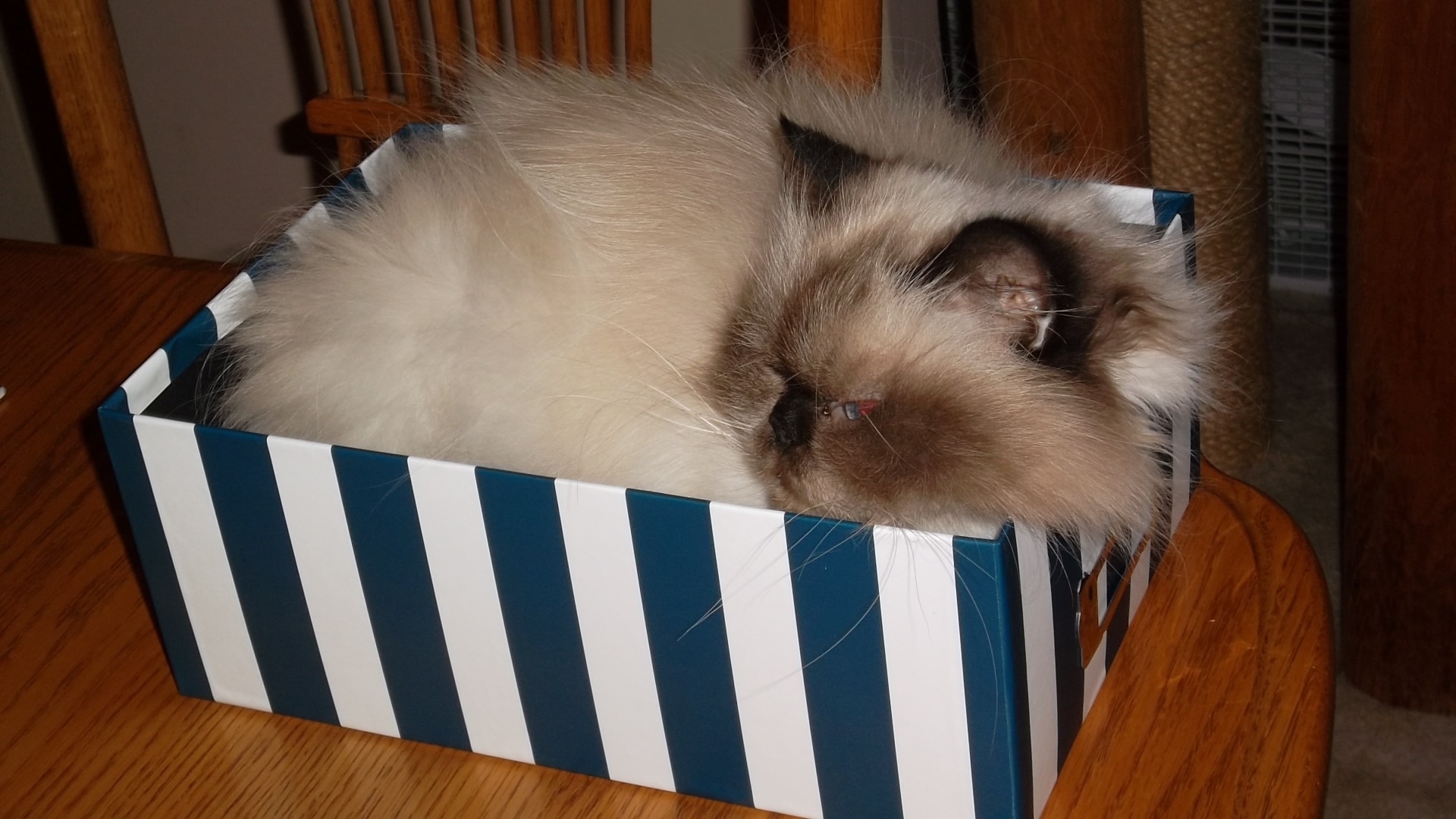
1. Empty cardboard box – ask your friends to mail you something, anything. Just to get that fresh and crispy white, blue and red cardboard box. A cat toy hand-delivered by the USPS!

2. Plastic ring found on gallon jugs of milk – as soon as that ring hits the ground, it will be batted around the kitchen like a hockey puck, or carried around the house like today’s kill. (please be careful with this one, they are easy to chew through).

3. Road map spread out on the floor – (Yes, people still paper road maps) Taking a trip? Get that map and spread it out on the floor. And then get a second map for yourself. Box 3 Nutmeg Trinity
4. Empty box – Perfect excuse to go shopping! Head out to the mall and buy a large item that comes in a box. Doesn’t matter what. New dishes, sewing machine, stand mixer, salad spinner. Just so long as it is large enough for the cat to dart into – and fall asleep.   Box 2

5. Bring nature into your home – let a fly into the house (if you don’t mind all your lamps knocked over)

6. Bring nature into your home – let a squirrel into the house (if you don’t mind all your lamps knocked over)

7. Take up knitting and leave the ball of yarn next to you on the couch. Just make sure you do not care how your knitted project turns out.

8. Take up needlepoint – your cat will watch with rapt attention as the thread appears and disappears on the underside of the woven canvas.

9. Roll a marble across a floor (hard surfaces, of course) – your cat will watch with fascination as you roll the marble to the other side of the room, go get it and roll it again, go get it, and roll it again, go get it….

10. Used shoelace – well, it doesn’t have to be used, I’ve been known to buy a fresh one. Not only will they drag it around the house like Linus’s blanket, but they will have hours of fun watching you throw one end of the string to them and then slowly pull it toward yourself, and then throw one end to them, and slowly pull it toward yourself and throw one end to them…

11. When you are finished making a casserole, peel off the aluminum foil and crumple it into a tight ball. Toss it across the kitchen or down a hallway and watch the cat run! And no need to explain to guests why you have 14 balls of foil in the living room, bedrooms, bathrooms, hallway…

12. The cheapest one – all you need is a watch and the sun. Hey, that rhymed! Happy accident. Anyway, line up your watch in the sunshine so the reflection ends up on the floor or low wall.
Box 4 paper bag

13. Laying paper bags on the floor – Next time the grocery store asks, “Paper or Plastic?” shout proudly, “Paper!” You may get weird looks from the employees, but they don’t know about the afternoon’s entertainment you have lined up.

14. Leave your shoes out in the open – forget to clean up after yourself, and your shoes can become the next best cat toy!

Different uses for products: Not all toys have to be common household items. I found two fantastic items at the craft store that make better cat toys than what they were originally intended:

15. Pom Poms sparkle balls – These are found in the kids craft aisle. I guess they are supposed to be glued onto projects like making a clown’s hat or something. We tossed one to our cat and he carries it around all the time.

16. The Original Squirmles, The Magical Pet – This is also found at the craft store. Supposed to be used by kids to do illusion-type tricks. But wow, cats go crazy for it! Even the ones the that don’t normally play – or move. Trust me on this one. Trust me. And hey, do me a favor – trust me on this one!

So next time your cat has a gall to tell you s/he is bored, pull out this list and let the games begin!