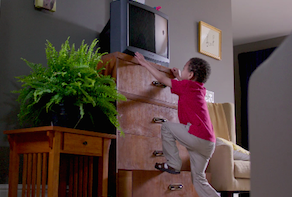
For every parent and household with young children, we have a message for you: one child dies every two weeks and a child goes to an emergency room every 24 minutes because a TV, furniture, or a combination of both tips over and falls onto them.
Children are natural explorers, and to them, the home is meant to be explored. As young children begin to crawl and walk, and test their abilities to climb, reach and accomplish things on their own, deadly hidden dangers are revealed. A recent Consumer Product Safety Commission (CPSC) study has uncovered some harrowing data:
There are an estimated 38,000 emergency-department treading injuries related to a TV and furniture tip-over incidents every year
81 percent of all tip-over incidents occur at home
And even more tragic, of all furniture and TV tip-over fatalities, 65% involve children younger than five.
With these statistics in mind, CPSC has launched the Anchor It! Campaign, a nationwide public education effort aimed at stopping child deaths and injuries that result from furniture and TV tip-overs. The goal of the campaign is to prevent these incidents by educating parents and caregivers with young children about the simple, low-cost steps to secure the furniture and TVs in their home.
“Unsecured furniture and TVs in homes with little ones who love to climb creates a dangerous tip-over scenario,” said CPSC Commissioners Marietta Robinson and Joseph Mohorovic. “We’ve launched the Anchor It! Campaign to give parents the facts on how to safely and simply anchor their TVs and furniture so we can stop these preventable tragedies.”
Advocates say tip-over incidents are almost entirely preventable, with more awareness and action.
“Prior to my son, Shane’s, death as a result of a tip-over incident, I did not know furniture and television tip-over deaths and injuries were an all-too-common occurrence in this country,” said Lisa Siefert, Founder of Shane’s Foundation. “Each of these incidents can be prevented with an increased awareness about the danger and the installation of low-cost anchoring devices.”
One of the contributing factors to electronics tip-overs relates to the purchase of new flat screen TVs. When consumers move older, and often times heavier, box-shaped TVs into a child’s bedroom or a family room, it is often placed on unstable furniture that is not intended for the size or weight of the TV – a place that can pose a great danger to children.
While a falling flat-screen TV can seriously injure or kill a child, a CPSC report indicates that older CRT TVs have the potential to strike a child with a force six times greater than a flat screen the same size. Thus, it is particularly critical that older TVs be secured so they do not tip over. Older TVs no longer in use should be recycled in an environmentally safe manner.
“When we see these statistics of child ER visits related to tip-over incidents, we know that we must take action now,” said Robinson and Mohorovic. “CPSC’s new Anchor It! Campaign is a call-to-action for parents and caregivers. We urge you to get on top of it, before the children do.”
The public education campaign will target parents, retailers, and the media. Public service advertising materials will be distributed in English and Spanish to broadcast TV stations, cable TV stations and to shopping malls, airports, and transit systems nationwide.
The campaign encourages the public to visit www.AnchorIt.gov, learn about the dangers and then take the necessary steps to eliminate the hazard in the home.
1/2 cup white whole-wheat flour or all-purpose flour
1/2 cup low-fat milk
2 large eggs
2 tablespoons canola oil, divided
1/2 teaspoon baking powder
1/2 teaspoon salt
1/4 teaspoon freshly ground pepper
2 cups fresh corn kernels (about 2 large ears; see Tip) or frozen
1/2 cup chopped fresh basil
Directions
Whisk flour, milk, eggs, 1 tablespoon oil, baking power, salt and pepper in a medium bowl until smooth. Stir in corn and basil.
Brush a large nonstick skillet lightly with some of the remaining 1 tablespoon oil; heat over medium heat until hot (but not smoking). Cook 4 cakes at a time, using about 1/4 cup batter for each, making them about 3 inches wide.
Cook until the edges are dry, about two minutes. Flip and cook until golden brown on the other side, 1 to 3 minutes more. Repeat with the remaining oil and batter, making 10 cakes total. Reduce the heat as necessary to prevent burning.
Tips and Notes
Tip: To cut kernels from the cob, stand an ear of corn on one end and slice the kernels off with a sharp knife.
Nutritional Information
Per serving: 180 calories; 9 g fat (1 g sat, 5 g mono); 86 mg cholesterol; 21 g carbohydrates; 0 g added sugars; 7 g protein; 2 g fiber; 329 mg sodium; 250 mg potassium.
Secretary of State Ruth Johnson today celebrated that the Michigan Organ Donor Registry now stands at more than 4 million people willing to be organ, tissue and eye donors, bringing the statewide total of donor registrants to 52 percent of adults.
“This is wonderful news for Michigan because organ, tissue and eye donation saves and improves lives,” Johnson said. “Add your name to the donor registry and become a hero. Every name on the list means hope for the 3,500 people in Michigan waiting for a life-saving or life-enhancing transplant.”
She broke the news to a thousand walkers and runners on Detroit’s Belle Isle at the 18th annual LIFE Walk, sponsored by Gift of Life Michigan’s Minority Organ, Tissue Transplant Education Program. The program is dedicated to reducing the need for organ and tissue transplants among ethnic and minority populations, who make up nearly 50 percent of patients waiting for a transplant.
In 2011 when Johnson first took office, only about 27 percent of the state’s adults were on the donor registry, ranking Michigan near the bottom nationally. Johnson made expanding the organ donor rolls a priority but insisted that it be done at little to no cost to taxpayers. She directed her staff to start asking customers if they wanted to sign up, created a task force of leading experts and began promoting organ donor registration at Secretary of State offices. About 85 percent of people who sign up do so through the Secretary of State’s office.
Since 2011, Michigan’s organ donor enrollment ranking has jumped from almost dead last to 35th in the country, matching the national average. About 2 million people, or one-fifth of the state’s population, added their names to the donor registry in the last four years.
Johnson credited this latest success to the hard work of Secretary of State staff, volunteers, and the Gift of Life Michigan and Eversight Michigan organizations.
“I’d like to thank Secretary Johnson and the SOS staff for all of the hard work that made this wonderful milestone a reality,” said Richard Pietroski, CEO of Gift of Life Michigan, the state’s organ and tissue donor program. “Lives are improved and lives are saved through organ, tissue and eye donation. Make the decision to be a donor and help the 3,500 people waiting for an organ transplant in Michigan.”
“Our mission is to preserve and protect the precious gift of sight and reaching 4 million on the donor registry is a great step toward that goal,” said Alison Wright, Community Relations Manager for Eversight Michigan. “I commend Secretary Johnson for this wonderful news and implore everyone who doesn’t have their name on the donor registry, to please add it as soon as possible.”
“With more than half of the state’s adults signed up to be organ donors, we’re getting ever closer to our ultimate goal of 100 percent participation,” Johnson said. “It is my belief that the more people learn about the benefits of organ and tissue donation, and the power it has to transform lives, the more likely they are to sign up on the donor registry.”
Every donor has the ability to save up to eight lives through organ donation and improve up to 50 more through cornea and tissue donation.
Anyone can join the Michigan Organ Donor Registry, regardless of age or medical history. Go to www.michigan.gov/sos or visit any Secretary of State office.
Editor’s Note: To speak to an organ, tissue and eye donor volunteer in your area, please call
Tim Makinen of Gift of Life Michigan at 866-500-5801 or Alex Teska of Eversight Michigan at 734-780-2675.
Many of us struggle to pay for the prescription medication costs every month, some having to choose between purchasing food and the medication. We have had insurance for years and only needed to pay our copay, but this year we were faced with having to cover a high deductable before our insurance takes effect. We were needing to cut our costs so I made a master list of all our medications and began to do the research. By using the internet you can compare prices, saving gas… and time.
Www.michigandrugprices.comwww.medtipster.comwww.goodrx.comwww.walmart.comwww.target.comwww.meijer.com/pharmacyhttp://familyfare.spartan.com/pharmacy When doing your research keep in mind that there are several stores that offer FREE medications for certain conditions while others offer discount programs or cards. It pays to do the research. Our research paid off, since we added up the highest price for all our medications it could cost us $2,000.00 per month, compared to the lowest cost of those same medication of $250.00 per month. If your Doctor feels you must use certain name brand medications ask if they have discount cards available from the drug/company rep. A good example for us was Eliquis the Doctor felt it was necessary for this medication to be used, yet the 30 day supply was average $388.00. 90 day supply average $1084.26. Our Doctor gave us a card from the Drug Rep bringing our cost down to $10.00 for 30 day. Lipitor Generic is FREE at Meijer for a 30 day supply yet can cost 17.57 – 106.99 at other stores Metformin is FREE at Family Fare for 30 – 90 day supply yet can cost as much as $272.97 for 30 day or 980.93 for 90 day supply Lisinopril 30 day supply as low as $4.00 as high as $34.69 90 day as low as $10.00 as high as $64.59 Meijer offers a Pharmacy rewards program that works along with Mperks after filling 5 you can receive $10.00 or after 10 you can receive $20.00 off your purchases in store. Some stores offer their own discount prescription program, it’s best to compare if there is a cost if it would be worth signing up for or not. We found that there may only be a few that were cheaper for us and we had to weigh the cost of the program to the savings over the year. Some stores offer Gift Cards, Store credits or other rewards programs if you fill a new or transferred prescription to them. These are some ways to help cut cost on other purchases. The time I spent doing this research has paid off saving us several thousand dollars over time. Do keep in mind that even if you do not have a membership at Sams Club or Costco you are still able to get prescriptions filled there. Like other retailers they are lower on some medications, yet higher on others.
Metro Health’s Metro Way 5K is our annual family fun run. Our goal is to get you and your family up and active. So this event welcomes all ages and abilities: walkers, beginning runners, children and even stroller-pushing parents in addition to seasoned runners. If registered before July 15, you will receive a free 2015 5K t-shirt. Awards include Overall Male/Female & 3 Deep Male/Female by age group.
Metro Way 5K Group (4+)
Thursday, July 30 • 6:30 pm
Early Bird – $20/person (until June 30) • $24/ person (after June 30)
Registration & Packet Pick Up Thursday, July 30 at Metro Health Farm Market • 9 am – 2 pm
Rockford Resident Kathy Ray was in total awe upon her first visit to The Richard & Helen DeVos Japanese Gardenat Frederik Meijer Gardens & Sculpture Park.
“The beauty, tranquility and elegance I experienced on my first visit brought me to tears, she told the WKTV Citizen Journalism team.
Janina Pollatz, a Junior at Easter Michigan University, learned the true meaning of relaxation upon her time spent at the garden.
“After a stressful school year and competing in track all season, it was so relaxing to walk in and just slow down and experience the peacefulness and calmness of the surroundings,” she remarked.
The garden features traditional components such as waterfalls, elevation changes, extensive boulder placement, authentic Japanese structures and a functioning teahouse. The Japanese Garden, embraces the essence of traditional Japanese gardens—tranquility, contemplation and beauty. The design effectively uses space to highlight contrasts between still and rushing water, between quietly intimate spaces and expansive open spaces, and between manicured and natural areas.
What a great opportunity to talk to Steve La Warre
We had the opportunity to speak with Director of Horticulture Steve La Warre for a behind the scenes look at the design and execution of the Japanese Garden.
“This is an eight acre addition located in the middle of the 158- acre main campus. It has been a four year ongoing project. Construction commenced in 2012 and we reached our fundraising goal of $22 million,” he explained.
That is the type of generosity that West Michigan residents can appreciate from the late Fred Meijer and wife Lena, Richard and Helen DeVos and over 200 community members.
Steve La Warre also shared the sheer uniqueness of working with designer Hoichi Kurisu to create this garden of innovation.
“He is from Japan and bought a house here in West Michigan and has been here for the past five years. During that time he transformed an expansive marsh and wooded valley into an international design that uses the garden space to its best potential as a sensory experience. Every tree, every boulder was placed by him. He is known for his use of space.”
“It has been a great honor for me to work on this very special project for Frederik Meijer Gardens & Sculpture Park,” said Hoichi Kurisu, the garden’s master designer and president of Kurisu International, Inc. “Fred Meijer’s dream for such a garden for his wife Lena, and of Richard and Helen DeVos has become my dream, too. My wish is that the beauty and tranquility of this space will touch the visitors very deeply for many generations to come.”
As the WKTV Community News team experienced the garden, we thought about how the environment would change throughout all the seasons and how every location played off our senses. And standing by the rushing waterfalls, and Zen style garden took our daily stress away. We also marveled at the innovation, the beautiful views, and how lucky West Michigan is to have the garden at our path.
That was the resounding question at the second annual Give On…To Live On event on May 7, 2015. The “heart” refers to the red heart insignia provided by the Secretary of State when you register to be an organ and tissue donor.
The Give On…To Live On event, sponsored by Gift of Life Michigan, was held, according to organizer Karla Huitsing, “To not only raise awareness, but also to celebrate life.” In attendance were many who had received life-saving organ transplants. Chef Oliver Hale, affectionately known as “Chef O,” is a two-time kidney recipient. Chef O confirms his heart-felt gratitude for the opportunities has been given stating, “I have been blessed. I have been given a second chance at life.”
Rick and Marci are friends for life
Also in attendance was Marci Prince who felt the call to become a “living donor” while watching an appeal by Kate Couric on television. “My family had always been involved in donating blood. After watching the program I knew it was my time to donate a kidney.” Soon afterward Marci would learn that her kidney was an excellent match for Rick Herlacher, a local man on the kidney waiting, whose need would also be the inspiration for the first Give On…To Live on gathering in 2014. Marci met Rick and the two bonded immediately. The transplant was a success and both Marci and Rick continue to speak on behalf of Gift of Life outreach efforts. Although Rick could not attend the event this year, Marci states, “Rick is living proof of the gift of life.” When asked about her personal giving, she responds, “ Isn’t that what the human race is designed to do?”
The fact is that the need for organ and tissue donors in Michigan is great. As of March 1, 2015 there were 3,497 patients awaiting transplant. Thousands of others need tissue to relieve their pain, heal their wounds, and help them see again. On average, 400 people are added to waiting lists every 20 minutes, while 14 people awaiting organs die each day.
The quest to raise awareness in our state is urgent. The Donor awareness movement in Michigan has increased greatly due to the actions of the Michigan Secretary of State. Instead of the passive approach of waiting to ask family members for organ donation after a death has occurred, the Secretary of State branches now active as people if they would like to register for organ donation when they are obtaining a license or state ID.
Dr. Luis Tomatis, Director of Medical Affairs for the Richard M. DeVos family and renowned cardiothoracic surgeon, led a panel discussion regarding organ donation in West Michigan. The panel consisted of Dr. Daniel Borreson, Surgical Director of Adult Renal Transplant at Mercy Health St. Mary’s and the Surgical Director of pediatric renal transplantation at Spectrum Health Helen DeVos Children’s Hospital; Dr. Muneer Abidi , oncologist with the Spectrum Health Medical Group Adult Blood and Marrow Transplant Program; and Dr. Martin Strueber, Surgical Director for the Spectrum Health Richard M. DeVos Heart and Lung Transplant Program. All stressed the need for increased awareness and the opportunity for Grand Rapids to become one of the leading transplant sites for adults, as well as children, in our state.
Dr. Abidi, who deals with blood cancers and stem cell treatments, reinforced the need for donor registry outreach, especially in minority communities.
Dr. Martin Strueber, who recently moved to Grand Rapids from Germany, saw the Medical Mile and the advancements in heart and lung transplants locally, and has ambition to grow the Center and make transplants more available in our area.
Dr. Borreson also sees opportunity for West Michigan to become a major transplant destination for two main reasons: First, Spectrum Health is a Regional Level 1 Trauma Center, increasing the availability of potential organs locally. Second, character of West Michigan is based largely on Christian values and altruism. When we see a need, we meet a need. One of the most important things stressed by Dr. Borreson is no matter if you have a heart sticker on your license, “Make your wishes known to your family.”
Many who attended the Give On…To Live On event were awaiting organs, just as Rick Herlacher was in 2014. Their hope and their prayer is that someone will be a match, someone will step up and offer the ultimate gift of life. Could that person be you?
To sign up on the Michigan Organ Donor Registry simply go online to giftoflifemichigan.org or call 1-800-482-4881. You can also go online or visit any Michigan Secretary of State branch to receive a red heart to place on your license or state ID. You hold the keys to saving another’s life—register today!
Mother’s Day has always been a time of celebration and joy, but not for everyone. It may be a time of hardship if a Mom is going through troubles– spending time in a shelter due to domestic violence.
Movers for Moms has been there to make life a little bit easier for many abused women in the West Michigan community. Two Men And A Truck has teamed up with local churches, schools and child care centers to collect donations for women who have dealt with domestic abuse. They provide items for mothers and children such as clothes, toys, and other necessary belongings on Mothers Day to give them hope in the face of a crisis. It’s a program that is worked on year long and this is the 8th year.
One of the daycare facilities that helped out this year was Rainbow Child Care Center in Byron Center. Stacy Shotko is their Regional Manager, and she is very excited about the Movers for Moms project.
“What a better place to do this project than at a child care center where we are seeing Moms and working with them every single day,” she explained.
Each year, Movers for Moms donates to a different local shelter and this year it’s Safe Haven Ministries. This non-profit helps women and children who have been victims of domestic violence.
Ana Doonan, Development and Communications Director of Safe Haven is appreciative of all of the efforts of this highly successful campaign.
“The donations really takes the children’s minds away from abuse. When you see them playing and reading books or watching movies, it is great,” she said.
Last year was a record-breaking year with more than 220,000 items being collected and donated to shelters across the country. To find out how you can help, please visit: twomenandatruck.com
This story has a happy ending, but a tough beginning.
Rick Herlacher of Rockford, Michigan suffered with a kidney disease that was discovered in 2001. He struggled through dialysis three times a week for four hours at a time and went through five surgeries within 12 weeks last year. It was a constant battle to live.
The continued search for a transplant donor finally came to an end. Family members didn’t work out–a total stranger did.
Enter Marci Prince from Hastings, Michigan. She saved Rick’s life by donating a kidney.
“I always wanted to be a donor and I just decided to go for it. I feel blessed to be able to do this,” she explained during a recent interview with WKTV Community Media.
Her selfless, courageous act of wanting to donate her kidney was nothing short of remarkable.
But what are the chances of a total stranger being a perfect match?
“This was a match beyond a match–one in a million,” Rick explained emotionally.
Marci gets ready for surgery with extreme courage and determination.
And so the process began. 26 tubes of blood, continual testing at St. Mary’s Transplant Center, and the surgery itself. Marci, who had been a smoker for 30 years, quit cold turkey when she decided to be a donor. The process involves major surgery and both were in the hospital for 4-5 days.
Rick definitely received the gift of life.
“I was ready to go. I knew right after surgery, when I popped right out bed, everything was going to be great. There was no pain. I walked 20 laps. The nurses were shocked,” Rick enthused.
Rick is ready to go
Rick and Marci are now great friends. They find it difficult to put into words the strong connection they have.
Both of them are continually monitored by the medical staff at St. Mary’s. Rick’s immune system works at 1/3rd his capacity and he can be more than three times likely to have cancer.
But, so far, so good, or should I say– SO GREAT!
“I live every day like it’s my last,” Rick said.
Knowing now all that is involved with being a donor, would she do it again?
“Hell yeah, I would do it again,” she said emphatically.
It is shocking to realize that an average of 18 people die every day due to the shortage of available organ donors.
In total, there are more than 120,000 Americans awaiting their organ transplants, while millions of people die each year without signing up as organ and tissue donors.
400 people are on the wait list right now in Michigan for a kidney transplant. There are people waiting to live, and dying while they wait –it is a statistic that calls us to action when we consider that only 38% of Kent County citizens are signed up as organ donors when their life has ended.
On April 25, 2015, from 9:00 am to 1:00 pm, the Kentwood Police Department and the West Michigan Take Back Meds Program will give the public the opportunity to prevent pill abuse and theft by ridding their homes of potentially dangerous expired, unused, and unwanted prescription drugs.
Bring your pills for disposal to the Kentwood Police Department, 4742 Walma Ave SE, Kentwood, MI 49512. The Department cannot accept liquids, needles or sharp objects, only pills or patches. The service is free and anonymous, no questions asked.
The West Michigan Take Back Meds Program is a joint effort between local pharmacies, law enforcement, wastewater treatment facilities and government agencies to provide residents with safe, convenient access to proper medicine disposal. Proper disposing of your unused medications will ensure that your medicines will not be stolen from the garbage, will not enter our environment, and eliminates the potential for abuse and overdoses at home.
For more information Contact: Volunteer Coordinator Viktoryia Highland @ 616-656-6571
Students and staff are invited to participate in Runnin’ Rebels.
by Tom Rademacher
Forget everything you’ve ever read or heard about the so-called “loneliness of the long-distance runner.”
At Lee High School, you’ll find a unique running club in full swing, an after-school fitness party where students and staff are invited to come together and embrace not only running, but the benefits of belonging to something greater than themselves.
It’s entitled the “Runnin’ Rebels” running club, the brainchild of David Britten, superintendent of the Godfrey-Lee School District, to which Lee High belongs.
Where another educator might pack up for the afternoon and head home after the bell rings, Britten sees an opening to make a difference in the life of a student or staffer. All they gotta do is show up with a pair of sneakers and a little desire.
“It actually began when I was in Wayland, and working as a principal, and we had a running club for 5th- and 6th-graders called ‘Little Cats,'” says Britten. “When I came here in 2002, we began the running club, and it’s been in place ever since.”
The district probably couldn’t have found a better advocate for running than Britten. A 22-year veteran of the U.S. Army, fitness has been an integral part of the superintendent’s regimen his entire life.
Britten shares his love of running with students and staff in an after school running club.
He ran his first River Bank Run in 1985, the Chicago Marathon in 1990, and has graduated in the last decade or so to ultra-marathoning, with races of more than 62 miles under his belt.
On the day I visited the high school, though, the only goal was to do your best on a loop established throughout the high school hallways that measures one-seventh of a mile long.
Enter the school’s gymnasium from the west side, and you’re immediately confronted by blur after blur, as students and teachers pass by in a counter-clockwise direction, settled in for a 30-minute stint.
“I needed to change my lifestyle, knew I needed to join this club.”
Britten is usually among the group, but today, he’s taking the time to explain the genesis of the club, the rationale for keeping it intact, and the impact it’s had on participants.
“For one thing, a lot of these kids don’t have anything to do after school,” he explains. “This gives them an avenue; otherwise, they’re just going to be hustled out of the building.”
His method of recruiting more and more students into the Runnin’ Rebels is simple: “I just badger ’em enough where they eventually realize that they can do something they didn’t think possible.
“I would have hated to do my next career and just deal with adults,” he says of the transformation from the armed forces to education. “I did that in the Army. But I want to be with kids, and I found I could easily encourage kids to run.”
During the “inside” season, which includes 30 daily runs from November until March – or until the weather improves to allow jogging outside — the goal is to cover the loop as many times as possible within 30 minutes or so.
For those who choose to walk – like Guidance Counselor Betty Killoran, for instance — that translates to a mile or two. For the speediest in the group, it can mean up to three or four miles, even a bit more.
Those who show up for at least 20 of the 30 inside runs qualify for a T-shirt, and this year’s giveaway boasts a quote on the back from one of Britten’s mentors, ultra-marathoner Dean Karnazes, which in part urges people to “immerse yourself in something deeply and with heartfelt intensity,” and implores those same people to “continually improve, never give up – this is fulfillment, this is success.”
Britten, 60, leads the club with humility. Rather than boast about his running achievements and coaching record in cross-country and track, he’s more apt to point out a day in his life when he did his best and scored average.
“I was addressing the senior class after they bombed the MMEs (Michigan Merit Examinations),” he recalls, and shared with them in a parallel way how he was able to complete only 68 miles of a 100-mile run.
“You know what a 68 is?” he asked them.
“It’s a ‘C.’ I was supposed to run 100 miles and get an ‘A.’
Students run inside during the winter.
Britten acknowledges that the lesson had some incidental “shock value,” because many of Lee’s students have never known anyone to run or even try to cover 100 miles at a stretch.
But what he wanted them to walk away with was the realization that if you’re capable of more, you can’t settle for average. “Be determined to do better next time,” he remembers telling them.
Britten’s philosophy is gaining momentum and drawing in more and more participants. In the beginning years, the club operated with a handful of runners. Today, it’s not unusual for dozens to turn out.
Among them is a social studies instructor, Tom DeGennaro, who has endured 14 knee surgeries. Just over a year ago, he weighed nearly 300 pounds and suffered from diabetes and high blood pressure.
Today, his weight is around 230 and he’s got his sugar and BP under control.
He began by alternately walking and jogging for intervals of three to five minutes. Now, he’s kicking out runs of up to six miles at a time. On the day I visited, he was celebrating his 124th straight day of running.
DeGennaro’s three daughters – ages 7, 11 and 13 – provide him extra inspiration: “I want to walk ’em all down the aisle some day.”
Lee High senior Jordan Lovett enjoys belonging to the club not only for health reasons, but because “I’ve made a lot of friends, and it helps relieve a lot of stress from high school. It gives us an escape from reality.”
Lovett hopes to study social work at Aquinas College, and compete for the school’s track and cross-country teams. “I probably wouldn’t be as good a runner as I am,” she says, had she not joined the Runnin’ Rebels.
Students run under motivational signs posted around Godfrey-Lee.
Sophomore Hector Grande is into soccer and martial arts. The running club is a natural extension of both, providing him an aerobic activity that, same as Lovett, doubles as a mental outlet.
“There are stresses in life that you need to get past,” he says, “and sometimes, running is the answer to that.”
For senior Paulina Cabrera, running may help pave her way into the U.S Marine Corps, in which she hopes to enlist following graduation. “I’m tired,” she said after cruising the halls for 30 minutes, “but I feel better for it.”
The Runnin’ Rebels don’t limit their miles to schooldays. It’s an active group that involves even more amateur athletes in summertime, at nearby Pinery Park.
That’s where alumni and parents will join students and teachers in a walk-jog-run that helps bind the school family to one another, often celebrating two and even three generations of Lee faithful.
Most the time, participants in the Runnin’ Rebels simply find their own pace and rhythm, without the need for a lot of coaching.
Not so, however, for some of the fledglings who turn out, especially during summer months.
“The young ones have to learn how to run,” Britten says with a measure of sageness. “At a certain age, they think everything’s a sprint.”
LaughFest 2015 was, as always, a fun family event.
by Tyler Lecceadone
Gilda’s LaughFest, the nation’s only 10-day community-wide festival of laughter, attracted attendees from across the United States, Canada and the United Kingdom during its fifth annual event. LaughFest officially kicked off on March 5 with an attempt to break the Guinness World Record for the most people wearing paper crowns.
Preliminary numbers indicate that more than 45,000 individuals attended LaughFest’s more than 270 ticketed and free events at 49 venues in Grand Rapids, Lowell and Holland. During the 10 Day event the festival featured over 750 artists and attracted visitors from 644 U.S. zip codes. In total, LaughFest tracked attendees from 34 states, Canada and the United Kingdom.
LaughFest 2015 didn’t breakany records for the number of people wearing paper crowns but it was fun trying.
“We are so grateful for the support that our community provides by coming out and enjoying the festival and learning about the important role laughter plays in emotional health,” said Wendy Wigger, president, Gilda’s Club Grand Rapids.
At Kickoff LaughFest 2015 Wendy Wigger hands out freebies to the crowd.
“Our community, our partners and our sponsors have been vital in helping us raise awareness of our mission and contribute donations necessary for continuing the work
done by Gilda’s Club Grand Rapids. This would not be possible without that type of support and I want to say thank you on behalf of the entire Gilda’s Club organization.”
While LaughFest officials are still determining the overall economic impact on the community for 2015, they have announced the funds raised through the “High Five” community match campaign. During LaughFest, and through the month of March, the campaign raised $40,610. For each five dollars donated to the campaign by individual donors, Amway Corporation matched each donation, up to $25,000. This allowed LaughFest to surpass its $50,000 “High Five” campaign goal by $15,610.
“If you ain’t laughin’, you ain’t livin’!” – anonymous
“Amway is honored to be able to donate the full amount offered during the ‘High Five’ community match campaign,” said Todd Woodward, vice president of
communications at Amway.
“It is important that the community understand that there are resources available for individuals who are struggling with emotional health needs. We are delighted that the funds will be used for children’s programming offered through Gilda’s Club.”
Proceeds and donations from LaughFest support free emotional healthcare programs for children and adults living with cancer, grief and loss through Gilda’s Club Grand Rapids. Proceeds from the event account for 10 -15 percent of the Club’s annual operating budget.
The healing power of laughter is no joke. Just ask Sister Sue Tracy, known by some as the ‘Funny Nun’ and by many others as the former oncology chaplain at the Lemmen-Holton Cancer Pavilion and Butterworth Hospital. A Dominican Sister for 55 years, Sr. Sue is well-known in the community as an inspirational speaker, a source of comfort, guidance and hope, and a local laugh expert.
Sister Sue Tracy is, among many things, a Certified Laugh Leader – giving her permission to be silly.
You may wonder, as I did, how does one become a laugh expert?
According to Sister, “It’s based on a lot of years of experience!”
HA! No kidding!
Experience that includes dealing with cancer for 29 years. Sr. Sue is a cancer survivor five-times over and if you ask her how old she is, she’ll gladly tell you, “74! I’ll be 75 in June. I started this journey with cancer when I was 46 years old. So to be able to turn 75 is amazing!” I watched her face light up at the thought of it.
At the time of this writing, she is challenged by the disease once again. For her, being diagnosed with cancer is not reason to repeatedly ask ‘Why me?’ It’s reason to ask ‘How will I react to having it?’ that’s important to her healing.
“When I think of humor, I think it’s going to help me jump start my immune system,” she explains.
“The humor I possess and make use of isn’t just because of cancer. I’ve always been funny. So I’m not going to allow cancer to take away my humor – It’s a natural tranquilizer, it’s free, it’s non-fattening and it’s contagious! It’s a God-given gift,” she laughs.
That’s typical Sr. Sue – a witty, wise and wonderful presence.
There’s no denying that cancer is serious and life-threatening as are many other diseases and circumstances in life. But Sr. Sue believes, “…having a light-hearted, affirming view is possible for any of us – no matter what the ‘mellofahess’ or the ‘muckity-muck’ is that wants to drown us!”
Sister Sue’s first experience with cancer was with her mother, who taught her to take life as it comes and make the best of it.
“My mother was a mentor to me in terms of seeing life as a gift and as a challenge. When it becomes a challenge, you rally whatever sources you can to meet the moment as it unfolds.
“She said, ‘Sue here I am, this is what it is and we’ll take care of it!’ She lived for 15 wonderful years after her diagnosis.” Her mother and father died the same year, both from cancer.
For Sr. Sue, having battled breast cancer in 1986 and 1993, then non-Hodgkin’s lymphoma in 1999 and many basal cell skin cancers in between, her most recent diagnosis, she admits, has been the most stunning and startling to accept.
“In June 2014, non-Hodgkin’s lymphoma was discovered in my cheek. Then in November, it had the audacity to go north to the brain! It’s only been in the last month that I’ve gained confidence that I’m gonna pull through. But there are certainly nervous moments about it.
“I may die of cancer some day, but not yet. I have this interview to do first,” she adds with a smirk.
When she finds herself facing the darker moments, Sr. Sue says there is no denying that it is happening. “I don’t run away from what is real. I don’t want to move into a pity party and I don’t want to be stuck in fear because that’s not going to help.”
As a result, Sr. Sue admits she has not had a ‘big cry’ over the situation.
“God has the big picture. It is meant to be – it is not a mistake. I wouldn’t choose it for myself or anyone else but here it is! I can’t back out of it or laugh out of it. But I can laughwith it!
“This is part of my spiritual journey as much as it is my cancer journey,” adds Sr. Sue frankly.
Her journey has led her to discover that it’s in being vulnerable and fragile that people become more connected to each other. “There’s a soothing sense of belonging when you’re in the midst of this. I feel I belong to other people on the cancer journey and I’ve treasured my opportunity to be enriched by other people’s stories too.”
Retired from being a chaplain for a little over a month, Sr. Sue has more time to take care of herself while still helping others.
“My God-given mission to journey with fellow cancer survivors will only stop the day that I breathe my last,” she says. “It’s what it is.”
In the meantime, there is no doubt that Sr. Sue is still looking for the opportunity to have a laugh or two – whether it’s dishing out a one-liner or receiving it. She loves to share a chuckle and great quotes! Here are two of her favorites that are worth remembering:
If you want to succeed in life you must pick three bones to carry with you. A wishbone, a backbone, and a funnybone. – Reba McEntire
Laughter is carbonated holiness. – Anne Lamott
As a fellow cancer traveler, I say ‘Amen’ to that!
For most people, St. Patrick’s Day typically includes spending time with friends and family having a few beers.
St. Baldrick’s Foundation is a national non-profit organization that raises money for childhood cancer research.
But for the St. Baldrick’s Foundation, St. Paddy’s day is spent a little differently. The foundation celebrates the holiday through a head-shaving fundraiser to raise money for children’s cancer research.
St. Baldrick’s raises money all over the country for cancer research, and for a second year, the event took place in West Michigan. This year’s host was the 84th Street Pub and Grille in Byron Center. This year the event raised over $45,ooo!
Pat Schrager of Byron Center is St. Baldrick’s local event coordinator. “This is the seventh year I’ve done it. We were doing it in Indiana where we lived. When we came to Grand Rapids, we were surprised it wasn’t here.”
While shaving your head can certainly be difficult for anyone to face, when it comes to a good cause, most people are up for the challenge.
Volunteers step up to have their heads shaved to raise money.
Bobbi Halas is one of those people. She faced the fear of shaving her head to give to the fundraiser.
“It was the weirdest feeling I’ve ever had and I was scared spitless,” Halas said. “But it’s such a great cause.”
Bobbi, along with many others, came out to show their support for children’s cancer research. Cancer survivor Allison Slagter was impressed.
“It’s really fun watching everyone so eager to shave their heads, because that’s kind of scary if they don’t want to,” Slagter said. “Everyone’s just really eager to donate”.
Money for cancer research doesn’t grow on trees. But hair does grow on heads
Schrager explains that the St. Baldrick’s donations are also helping West Michigan local hospitals fund cancer research including the Children’s Oncology Fund, their largest benefactor. “And Helen DeVos Children’s Hospital participates in that,” adds Schrager.
Although the event is only in its second year in West Michigan, Schrager says the number of eager donors is growing.
“As you get people involved and start talking about it, they realize it’s only hair, it grows back,” Schrager said.
The second annual seed exchange educates the community about saving heirloom seeds.
While some people ventured downtown for the West Michigan Home and Garden Show, those with an eye on sustaining and promoting local produce gathered at the Kentwood District Library for the second annual Grand Rapids Community Seed Exchange.
The seed exchange was sponsored by NoGMO4Michigan. Event organizer, Tanya Hawley, explained that the seed exchange program, “educates the community about growing and saving heirloom seeds. This forms a connection between individual gardeners, local farms or Community Supported Agriculture (CSA), and farmer’s markets.”
In recent years seed exchanges have become more popular among those who wish to avoid GMO (genetically modified organisms). Speaker Ryan Kelly from NoGMO4Michigan began the day by highlighting the history of seed saving, going back to colonial days. Kelly then explained the difference between hybrid produce, such as crossing two types of apples to create the Honeycrisp apple; two of the same species combined to make a new type of apple. GMO produce, on the other hand, is created from injecting bacteria into produce a DNA mutation of the product. These GMO products can, themselves, be classified as pesticide products. The resultant produce are bred for uniformity and shelf life, not taste.
Parsley ready to harvest.Breakout sessions educate local gardeners.
Seed exchanges are utilized for those who save the seeds at the end of the growing year to strengthen the healthiest and tastiest crops and to make them thrive in the local Michigan climate. Heirloom seeds can be like expensive jewelry or furniture handed down through the generations.
Throughout the day breakout sessions were held on topics such as hydroponics, urban gardening, the basics of seed saving, and the importance of local produce. Don Rewa also spoke on the “Amazing Honeybee” and the consequences of declining numbers of honeybees in recent years and the natural process of pollination they provide.
Andrew Bostick of Earthkeeper Farm runs a Community Supported Agriculture, a locally based model of agriculture and food distribution.
Rachelle Bostwick, of Earthkeeper Farm, set up an interactive display for participants to learn how to separate and save the seeds from parsley plants. Bostwick and her husband, Andrew, use only organic and biodynamic practices and boast a USDA Stellar Certified Organic Produce rating. Their farm, as many of the farms represented this weekend, operate a CSA. Community Supported Agriculture is a locally based model of agriculture and food distribution. It is a group of people who financially support a farm and their growing efforts in exchange for a share of the food produced. You can pay a seasonal fee or volunteer for work shifts for the anticipated harvest. As harvest season begins, you’ll be able to pick up your “share” of food – which will change as the season changes.
In the spirit of growing and saving seeds of heirloom plants, the Kent District Library system now maintains the KDL Seed Library, operating at 14 local branches. Michelle Boisvenue-Fox with KDL offers a diverse and strong seed stock collected from Wild West Seeds, Earthkeeper Farm, Seed Saver Exchange, High Mowing Organic Seeds, Wintersown, and Seeds of Change.
“People just need to fill out a participation form, take free seed samples, and hopefully bring back seeds at the end of the season to build the seed library.”
You do not have to be a library cardholder to participate. Local branches will have their displays set up within the next several weeks.
In recent years seed exchanges have become more popular among those who wish to avoid GMO (genetically modified organisms).
Having only the experience of backyard gardening, and buying the bulk of my produce from local stores like Meijer, Family Fare, and Horrocks, the seed exchange was very eye opening and informative. For more information on local produce, GMO-free seeds, and CSA cooperatives you can contact the following:
Earthkeeper Farm
Green Wagon Farm
Chimney Creek Farm
New City Urban Farm
Blackbird Farm
Growing Green Family Farm
Growco
Another source of information is the Grower’s Fare, Community Supporting Agriculture, taking place at the Downtown Market on March 15, 9 a.m. to 2 p.m. Hear from farmers about what they’re growing and how to use your produce all season long. There will be presentations on health and nutrition, produce share, and cooking demonstrations.
Me, Janice Limbaugh, Queen of Knuckleheads and Breast Cancer Survivor
by Janice Limbaugh
We came. We crowned. We danced. We cheered. LaughFest 2015 kicked off with great enthusiasm last night despite the failed attempt of breaking the Guinness World Record for the most people (1,324) wearing paper crowns. Four-hundred eighty-nine of us had a blast trying.
As the nation’s only community-wide festival of laughter, Grand Rapid’s Gilda’s LaughFest is, in and of itself, a good reason to smile, laugh, dance and cheer. When and where else are you permitted – invited even – to be silly for the sake of it? Little kids do it so naturally and with perfection while most adults need a memo of approval to goof off. And when they do, they feel great! Having fun is necessary to good health. That’s what’s so cool about LaughFest – everyone involved – from the volunteers to the participants to the performers are out to have a good time. Laughter is contagious with lingering symptoms of happiness to follow.
Everyone attending agreed that Fountain Street Church was the best alternative location to Rosa Parks Circle – It was WARM!
So although it was unfortunate that for the first time in five years, we weren’t able to break a Guinness World Record, I bet we’re breaking records for the city with the biggest laughs on earth. Get your grin on West Michigan! It’s does a body good!
Visit www.laughfestgr.org for event information or call 616-735-HAHA (4242).
I have a life-long passion for Creation Care and Earth-keeping. Recently, I have discovered the online site called Green America and its wealth of resources on how to live in harmony with our Earth, including on how to advocate divesting.
Basically, divesting means refusing to invest in or use companies, products and processes that damage people and pollute our planet, or if you already own products or stock in those companies, it means shifting your dollars and purchasing power to protest their continuing actions that abuse our planet and ultimately us, the people who live here.
Green America has a long history of exposing harmful fossil fuels (coal, oil, and gas carbon) extraction as well as consumption. For me, Creation Care includes divesting from fossil fuel companies and reducing consumptive lifestyles and use of their products and processes. This also includes divesting from big banks, multinational corporations and associated credit cards intertwined with fossil fuels that pollute and exploit the disenfranchised, the marginalized and the planet.
It further involves reinvesting into clean renewable energy (NOT nuclear) and into life and community-building alternatives.
Green advocacy groups, such as Green America and others, have long been concerned over the devastation and pollution from fossil fuels, including their extraction, consumptive use and end-products. At the present rate of escalating use, fossil fuel emissions of carbon dioxide into the atmosphere are causing catastrophic and irreversible man-made global warming and climate change. The results are grave effects on our planet’s health (human and animal) and human rights.
I agree with Bill McKibben of 350.org that in order to preserve our planet, carbon dioxide formed by extraction and consumption of fossil fuels, MUST be reduced from current levels in the atmosphere to below 350 parts per million. Advocates, including Green America, urge this reduction, and for us to make clean-energy economy a reality by refusing to invest in companies that are destroying our planet. They further urge the shifting of investment and purchase dollars into alternative, clean, renewable energy such as solar, wind and hydro. These sources prove to be more life and community enhancing. This can also be achieved by supporting public policies and lifestyles that move us away from fossil fuels.
To me, divesting and reinvesting are crucial for the common good! My identity is in life-long, deep soul-searching passion for Biblical Christian faith and discipleship to Jesus Christ. My passion flows with the mission of Creation Care: stewardship, equality, solution-focused global and local justice for people and the planet; in other words, living simply so that others may simply live.
Note: Martie Jager recently presented at the series Our Changing Climate & Positive Earthkeeping Responses presented by Hope Reformed Church at Burton St. and 2210 Kalamazoo Ave in Grand Rapids. The sessions run 11:15 a.m. until noon every Sunday through May 3 (except Easter). The schedule for the remaining sessions is below:
Part II: The Church
Sunday, March 8 Caretakers of the Earth – Steve Bouma-Prediger
Sunday, March 15 What’s Happened at Hope Church, Holland? Peter Boogaart
Part III: Local/Regional Issues & Efforts
Sunday, March 22 Grand Rapids and its Environment – GR Mayor George Heartwell
Years of unrestricted dumping of pollutants into the Great Lakes have created several trouble zones where even fish can no longer live. The Environmental Protection Agency (EPA) describes these hot spots as “a location that has experienced environmental degradation,” dubbed Areas of Concern (AOC).Michigan’s U.S. Senators Gary Peters and Debbie Stabenow, both members of the Great Lakes Task Force, recently announced that the National Oceanic and Atmospheric Administration (NOAA) is awarding $7.9 million to fund habitat restoration projects in the Great Lakes Areas of Concern.The Great Lakes Commission will lead a regional partnership in coordination with NOAA, the Great Lakes states and local agencies.
The U.S.-Canada Great Lakes Water Quality Agreementdesignates AOCs as sites with the worst legacies of toxic contamination and environmental degradation in the Great Lakes ecosystem. The EPA currently lists 11 different AOCs in the State of Michigan.
A list of the 43 AOCs identified includes 26 located entirely within the United States, 12 located wholly within Canada, and 5 that are shared by both nations. To see the areas of concern on a regional map of the Great Lakes check out this link:
The list of ways hunger can affect a child’s health is a long one. Chronic health issues like asthma, behavioral issues like anxiety and social issues like bullying are just a part of that list.
Nan Evans has seen children sneak food in their pockets and fight over a piece of breakfast food.
“When they’re hungry, they’re fidgety,” said Evans, principal of Kent Hills Elementary School in Grand Rapids. “They can’t focus. Getting mad and making trouble from being hungry can be how they express anger in inappropriate ways.”
Kent Hills is far from alone in dealing with the problem of hungry and undernourished children. According to Kids Food Basket, an agency that provides students with meals, more than 30,000 area children — that’s about 20 percent of the children in West Michigan — are at risk of hunger.
Studies have shown hungry children living in poverty are at high risk for chronic health conditions such as asthma and frequent oral health problems; more likely to require hospitalization than children who eat regular meals; and more prone to behavioral issues and social difficulties such as aggression, hyperactivity and irritability. They are six times more likely “to be in less than optimal health, experiencing a wide variety of illnesses and injuries” compared with children from higher income families, according to the Great Lakes Center for Education Research and Practice.
When it comes to schooling, hunger and malnutrition can hurt students’ achievement in a number of ways, educators and health officials say.
“It is important that they ingest important nutrients for optimal functioning in school,” said Stephanie Painter, director of Spectrum Health’s School Health Advocacy Program.
“We know nutrition is important because research has demonstrated that if children lack food, they are more likely to be in special education, have behavior or conduct disorders, be obese because of food insecurity, be at risk for psychiatric problems, be unable to focus or pay attention, and also are at risk for disease because they are anemic.”
A Pantry at School
Principal Nan Evans at Kent Hills Elementary’s monthly mobile food pantry.
Kent Hills is one of several area schools taking a direct approach to student hunger. It works with Feeding America West Michigan to hold a mobile pantry the third Wednesday of every month.
A semitrailer full of donated food backed up to one of the school’s double doors on a pantry day earlier this year. Volunteers unloaded the food onto rectangular tables filling the hallway. Soon, the tables were packed with potatoes, apples, bread, crackers, desserts, yogurt and sausage to be distributed to the 90-plus people in line.
One of the people in line was Rhonda Hawkins. Her grandson attends the school, and she lives with him, her dad and daughter. The food she picks up at the mobile pantry will help them a lot, she said.
“We can go a few weeks with potatoes and stuff,” Hawkins said. What they can’t do is go to the cupboard and wolf down as many Pop Tarts as they want. The food they get is managed carefully to go as far as it can.
Hawkins’ daughter, Keli, was standing in line with her. The food they pick up at the mobile pantry is used “pretty much with every meal or snack,” Keli said. “If we have extra potatoes, we give it to the elderly couple across the street.”
Cassandra Butler was in line with two teenagers who didn’t want to be named. “This is good when people are low-income and trying to make ends meet,” Butler said. “I got cut off my food stamps after Christmas. You do what you have to do when it comes down to eating.”
Feeding America West Michigan is working on expanding mobile pantries like these, which have also visited Dickinson Elementary, three Grand Rapids high schools and North and West Godwin elementaries this year. The agency supplies nearly 1,200 food pantries, soup kitchens and homeless shelters in 40 counties in West Michigan and the Upper Peninsula.
How Food Can Change Things
Kids Food Basket is another local organization seeking to help with children’s hunger. It sends sack suppers home with more than 6,000 children in the greater Grand Rapids and Muskegon area.
When children do get enough food, the results can be wonderful. Julie VanGessel, program manager for the Kids Food Basket Kids Helping Kids program in Grand Rapids, has seen it happen.
She remembers watching a class once and complimenting the teacher on what a great group of students she had. The teacher told her the class used to be difficult before they realized the students were hungry from lack of nutritious food. When a way was found to provide them with more food, their behavior, attendance and test scores all improved.
“It’s because they’re not hungry,” VanGessel said.
Rhonda Hawkins and her daughter, Keli, in line for donated food.
Families faced with hunger often skip meals and buy cheaper, less nourishing food because that’s all they can afford, said Emma Garcia, hunger response director for Access of West Michigan, a network of food pantries and anti-poverty programs.
Eating the empty calories of cheap foods like macaroni and cheese can lead to health problems including obesity and diabetes, Garcia said. That’s why organizations like hers work to make sure the food they give out is nutritious and includes the five food groups. Providing families with food that is “just calories doesn’t do them justice,” she said.
VanGessel agreed, saying, “It robs kids of their energy and their health.”
Inside the sack supper Kids Food Basket sends home with students is a meat or cheese sandwich or a tortilla roll-up for protein; one serving each of a fresh fruit and vegetable; a fruit juice box; and two healthy snacks like a granola bar or string cheese. Providing such balanced meals “helps kids stay focused, get their homework done, and stay on track with other children,” asserts the agency’s website.
Too Long Between Meals
Another issue agencies are trying to solve is the time gap some children face between meals. VanGessel tells of a mother working two part-time jobs, raising two daughters on a fixed income and going to college. When the mother noticed her kindergartner was coming home daily with headaches and struggling with homework, she thought it was a medical problem. Her child’s health issues actually stemmed from the many hours without food between getting her free lunch at school and eating dinner at home.
“They get breakfast and lunch at school, but if mom works until 7 p.m. and the meal comes at 8 p.m, and the last food they had was lunch at 10:30 a.m., it’s a huge gap of time,” VanGessel said.
“Sack suppers became a saving grace for this family,” she added. “Not only did the young student’s hunger headaches disappear, but she was back to her playful self, with energy to complete her homework assignments.”
Being diagnosed with cancer is daunting enough for a person to deal with but many cancer patients face an additional hardship: transportation to and from medical treatments. They either have no transportation or do not feel well enough to drive.
According to the American Cancer Society (ACS), the need for transportation is second only to direct financial assistance. That’s why the ACS began the Road to Recovery program, connecting patients with specially trained volunteer drivers who donate their time and personal vehicle to transport them. The service is free and thanks to the generosity of the drivers, it’s a lifesaver for the cancer patients to get the treatment they need.
“It’s just one less thing they have to worry about,” says Mindy Klein, West Michigan’s ACS program manager.
Unfortunately right now, Klein says the need for more volunteer drivers in Kent County is critical.
“We’re actually getting more requests than we have drivers to accommodate,” Klein states. “We have to turn them away or find another resource for them and we don’t want to have to do that.”
Currently, the active number of volunteer drivers is between 15 and 20 people she says. “We need many more drivers to accommodate the number cancer patients who need this service. Any amount of time a volunteer can give to transporting a patient is greatly appreciated – not only by the American Cancer Society but by the patients themselves.”
Klein goes on to explain that the ACS considers the volunteer’s availability and weekly schedule before matching them with a patient. It goes without saying that treatment appointments are usually Monday through Friday during working hours. Some cancer patients need treatment daily while others may need treatment every other week. “It varies according the patient’s diagnosis and treatment plan,” says Klein.
To be eligible for the Road to Recovery services, Klein says all one needs is a cancer diagnosis and a phone call to the local American Cancer Society. To be a volunteer driver, participants are required to complete a short online training program, a background check and a motor vehicle check. It’s an easy and flexible way to make a positive impact on someone’s life.
“Many of our current volunteers have developed close relationships with their patients and often tell us that while the patient is extremely grateful, they too are greatly rewarded,” Klein says.
To find out how you can volunteer to be a Road to Recovery driver or to find out more information about this program or many other Soceity programs, contact the local office of the American Cancer Society at 1-800-227-2345 or visit cancer.org.
In part one of Lou Haveman’s story about Creation Care, Lou wrote of his family background in rural Michigan as an inspiration for his commitment to installing and promoting solar energy systems. His childhood built an appreciation for nature into his life.
In part two, Lou writes about his decision to move forward with the installation process even after he got a bid of $40,000 to make it happen. Bottom line – start wherever you can afford to and plan to grow.
We started with 4.5 KW system, about 50% of what we need. I took the 30% tax credit and saved just shy of $800 off the first 12 months of my Consumers electric bill. In the meantime I received three S-REX (Solar Renewable Energy Credits) each worth about $15.00. These credits will continue to grow the more alternative energy I contribute to the grid. I have a system that is estimated to last 40 years with a payback in about nine. The tax assessor did not raise my assessment. However, the value of my property increased substantially. Over-all not a bad investment looking just at the economics.
When it is hot and sunny. I do not complain. The electric meter is running backwards. When it rains my garden flourishes and produces. The Solar panels work every day and require zero maintenance unless I want to brush off the snow. My carbon foot print is zero. I love to read my solar inverter. As of today I have “saved” 6,364 lbs. of CO2. Best of all I believe in creation care, living within and on the abundance of energy God through nature has already provided…free!
Yet, this is only the beginning. I feel like we are only at the model T stage of renewable energy. As I think about expanding, technology already has expanded. Here are a few new things we are thinking about:
Complete our system to cover 100% of our energy needs.
Add a solar circuit to our breaker box so I can run the furnace fan and thermostat independently of our grid.
Purchase a 100% electric vehicle.
Build a solar powered hydroponic high density garden with a fish pond as a nutrient base.
And there is so much more: geo-thermal, replacing the gas HWHs with electric on demand, more LED lights…All of this should keep us busy for a while!
A cold grey day in Michigan may not seem like the best time to rely on solar heating systems, but Lou Haveman in Grandville would disagree. “We produce our own electricity,” says Lou, “and when we produce more than we need, it goes back on the grid.” More than he needs to power a house full of appliances, including his furnace? Yes, even in the coldest weather.
Lou still gets some of his electricity from Consumers Energy. But in December 2013 he installed a solar system in his home and spent all of 2014 watching his energy bills go down by nearly 60%. At 12 cents a kilowatt, that adds up to a savings of about $725.
It wasn’t all about saving money for Lou. He’s a strong supporter of what is sometimes called Creation Care – acting as a loving steward for Planet Earth http://www.creationcare.org/
Lou explains, “Simply to live in balance with nature, recognizing environmental issues need to be addressed. It’s one thing to talk about it, it’s another thing to act on it.”
And it’s not easy to take action. “Consumers Energy actually has a lottery system. They allocate so many kilowatt hours for solar. You submit your application and by lottery if you’re selected, then you’re approved.” Lou says finding someone you trust who is skilled and experienced in solar installation is critical. “Initially, I’m pretty handy. I thought this is something I could do, but realistically that isn’t a viable option.”
Some rebates or tax incentives are available for homeowners who want to install alternative energy programs. But even though Lou got lucky in the lottery, eventually found Solar Winds to plan and install his system, and qualified for a 30% tax credit, he still had to spend about $20,000 to make it happen. Still Lou looks to the future. He expects to recover all the cost of the installation in about 10 years’ time, after which his electricity will be virtually free.
“But in addition to that,” says Lou, “it’s just incredibly rewarding to look at that meter and see it run backwards. I realize not everyone has the financial resources [to invest in alternative energy], but if we do I think it’s imperative that we do so.”
For a video version of this story, click on the play button at the top of the page.
Growing up on a farm helps one have an appreciation of nature. We never had a lot but we had an abundance of healthy, home grown vegetables, butchered our meat, and raised our own eggs and poultry, cut our own firewood to heat our home. Mom canned and later froze our produce. We had a fruit cellar for the potatoes. Carrots we dug out of the snow covered ground. We would purchase apples by the bushel and make jars and jars of apple sauce. We did not know much about environmental issues and never heard about climate change.
We were ignorant. The icicles hanging from our kitchen roof I thought were beautiful and never considered adding to the four inches of insulation in the attic. We hauled our few throw-away aluminum cans to a dry creek bed in the back forty. Our drain field, it turned out to my surprise, was the country drainage ditch from which our cows drank. We swam in the larger creek a half mile from our home. We were poor and had no money for herbicides. What pollution we caused was easily covered by the hospitality of nature.
College came and went. I became aware of the word ecology. After living in Africa for 16 years we returned to Michigan where I had found a job selling and later installing Blackberry Solar Systems for heat. It made economic sense…barely…because of the Michigan solar tax credit in the early 1980s. Gas became expensive.
Living in Africa and working in agriculture community development I had learned what it means to live simply, living in balance with nature, and being abundantly careful with the limited resources poor people have. It became a motivating factor of my life.
I purchased a large solar water heating system for a multiple rental unit we owned. Every home we lived in I established a flourishing garden. We recycled everything. We sought ways to be energy efficient. In 2013 Jan and I visited an organization called New Vision Renewable Energy in West Virginia. I saw how one could build a hydroponic garden raising vegetables where recycled water from a small fish pond became the nutrient basis for the vegetables. It was powered by solar. We sell hundreds of small solar telephone chargers and light all over the world through our small international business (www.businessconnectworld.com).
I had to take the next step, a big one, and expensive. I calculated what it would cost to provide 100% of our power off solar. The system would cost me over $40,000.00.
Learn what steps Lou took when he learned what installing a solar system would cost him – and whether this challenge altered his commitment to Creation Care. Watch for part two of the story Friday and accompanying video.
While something like cigarette smoking is easy to detect as a cancer causing agent in your home, something less obvious is radon gas. It’s a radioactive gas that comes from the soil and is the second leading cause of lung cancer in the United States.
“[Radon] makes its way into your home through the foundation,” owner of Radon Control Services Patrick Bird says.
Spectrum Health Plumonary Critical Care Physician Glenn Van Otteran says 10% of the lung cancer causes they see at the Spectrum Health clinic are radon related. “We can only make estimates, but I would say about 30-40 [cases] a year are related to radon exposure.”
The Environmental Protection Agency’s website identifies areas with the highest risk as located in southern Michigan; Kent County and other inland counties have a mild risk; and the lake shore areas face even less likely risk. However, owner of Buyer’s Home Inspection Branden Vanderhoof says that doesn’t mean the radon problem isn’t prevalent in West Michigan.
“ [Radon exposure] can change over time, so it’s suggested that you test every couple of years,” Vanderhoof said. “Some parts around the Grand Rapids area there is a lot more than other parts.”
Vanderhoof explains that about one of every three homes in the Grandville and Jenison areas may detect radon in their homes, whereas only 1 out of every 20 homes are threatened in other areas of the state.
Vanderhoof says that avoiding radon in your home is almost impossible, but there are several ways you can protect yourself from the deadly gas. The first step is to get your home tested, which you can do yourself. Pick up your own testing kit at your local health department for a minimal fee.
If you’re selling your home and looking for quick, credible results, Vanderhoof says hire a pro, called a “mitigator.” Owner of Radon Control Services Patrick Bird says “Unfortunately there are some who don’t take any steps forward and of course that’s where your elevated health risks come into effect.”
Because radon can cause lung cancer, people who find high rates of radon in their homes may want to check on their health as well.
Dr. VanOtteran says there are no specific tests to indicate whether someone has gotten lung cancer from radon exposure-but different types of cancerous cells provide clues. Rates of exposure can also play into increased risk.
“Studies indicate that your risk of getting cancer related to radon exposure is related to not only to the dose of radon exposure, but the duration,” Dr. VanOtteran said. “Typically, that’s over many years.”
Vanderhoof says the number one way to avoid any health risks is to have your home tested and significant rates of radon gas mitigated with a system that’s typically installed in your basement.
West Michigan honors the contributions of African Americans to the rich tapestry of our nation’s history. Organizations including local universities, social clubs, and institutions such as public libraries will feature special displays, exhibits, and events dedicated to recognizing the unique stories and achievements of Black Americans.
GVSU Office of Multicultural Affairs Events
GVSU will host several events to honor Black History Month. For dates and locations, click on the link for details.
Taste of Soul Sunday at Grand Rapids Public Library
Join the GRPL as they celebrate African American history and
Imani Singers of Grand Rapids
culture at the tenth annual FREE Taste of Soul Sunday. Parking is always free on Sunday in the library lot. The parking ramp at GRCC (north of our building) and metered spots on the street are free on Sunday as well.
Spectrum Health Healthier Communities, 655 Seward, Grand Rapids, MI, (4th Tuesday of every Month). FREE and open to the community with free parking in the lot and on the side streets. Build relationships, your knowledge of racial equity, and learn about advocacy to create ideas for action, recruit the help of others, and implement work that can help eliminate racialized outcomes in our community. Email Colin Smith with questions.
Saturday, February 28 –5:00 – 11:00 pm
Celebration of Soul
For 14 years, the Grand Rapids Symphony’s Symphony with Soul concert has moved diverse audiences with jazz, opera, gospel and R&B. On February 28th, Vanessa Williams will perform her greatest pop hits alongside the Grand Rapids Symphony orchestra. The Grand Rapids Symphony is proud to collaborate with the Community Inclusion Group to bring the NAACP Image Award-winner and Grammy-nominated artist to DeVos Performance Hall.
The concert is part of the evening’s Celebration of Soul gala, which is celebrating its 10th year. DeVos Place, Steelcase Ballroom, 303 Monroe Ave NW, Grand Rapids, MI 49503
Teens from Saugatuck High School present an in-depth look at the question of teen homelessness as experienced by young people in the foster care system at the “Intriguing Conversation” series on Thursday, February 12. The program at the Saugatuck Center for the Arts (400 Culver Street, Saugatuck, MI) begins at 7:00 p.m.; free admission. For more information click on the link
The issue of teen homelessness is quite complex. According to Bethany Christian Services, a big challenge is children who turn 18 in the Michigan foster care system. About 30% of the youth that age out of the foster care system end up homeless within 2 years.
Currently, there are 292 children in the state of Michigan between the ages of 8 – 17 in foster care awaiting adoption. Without a permanent home, they are turned out of the system with no home, no job, no pathway to education and no support systems.
Last week 27 people from the Kent County area bundled up on one of the coldest nights of the year to check under bridges, overpasses, and parks. They were looking for their fellow citizens, people technically classified as “homeless.” Jim Talen, coordinator for Kent County’s 2015 Point in Time Count of homeless residents, says total numbers of homeless in Kent County are expected to range somewhere between 650 to 800. “Last year we counted a little over 790 and we expect to be close to that this year,” says Talen. Numbers are not broken out by community.
Rebecca Rynbrandt, Director of Planning and Community Development for the City of Wyoming, says that communities in Kent County work together to care for the homeless, so services are centralized. “We want everyone to know that calling 2-1-1 is the way to access services for people who fear they will become homeless or those who already are.” The City of Wyoming publishes a pamphlet on homeless issues available at this link: Community_Outreach_Trifold.pdf
It’s the start of February in Michigan which means endless days of cloudy gray skies, brisk biting winds and a case of the winter blahs. For me it’s all that and more as I enter into the second phase of my breast cancer treatment, radiation.
Grateful to be done with the chemo, I am left tired, pale and hairless in the dead of winter. “From here on out, it’s growing season!” I tell myself even though looking my best and feeling better about myself is a daily challenge. From deciding what to wear on my head (for warmth and comfort rather than sex appeal), to avoiding clown makeup, getting ready to go out for the day has been less than inspiring for my social confidence and kicking cancer’s butt!
So it was indeed a godsend when I discovered a brochure for the Look Good Feel Better program at the Resource Library in Lemmen-Holton Cancer Pavilion. Thanks to the Personal Care Products Foundation, American Cancer Society, and Professional Beauty Association, I, or anyone with cancer, could attend a FREE two-hour makeover workshop to guide me in dealing with appearance changes during my cancer treatment. Wow! And when I signed up and was told I would also be getting a FREE makeup kit filled with quality products to take home – it was like a little ray of sunshine broke through my gloom to give me hope! Ahhh!
Cosmetology professional, Ronna Kilts has been driving from Newaygo every week for over a year to volunteer her time and talents to helping women like me feel empowered and beautiful in the face of cancer treatment. Kilts says her inspiration to do this came from her aunt, also a cancer survivor, who went through the program herself.
“The day I graduated from cosmetology school I signed up to do this,” Kilts says. “It was something I knew I had to be involved in. It’s a great program, it’s fun and it’s super rewarding!”
The Look Good Feel Better program is a step by step guide to teach women about makeup, skin, nail care, wigs and other head coverings used during cancer treatment. It is a free, non-medical workshop and does not promote any one brand. Products in the kits have been generously donated for the cause and come in light, medium, dark, and extra dark to match your skin tone.
We started our session with brief introductions before turning our attention to the contents of the Look Good Feel Better makeup kits. You’d think it was Christmas morning for the three of us who participated as we examined each item individually, impressed by the brand names at our disposal. Although no two kits are alike, they all contain the essentials such as concealer, foundation, powder, blush, etc. With ooohs and aaahs and giggles of delight, (because we were all anxious to look good and feel better!) we were eager to get underway. Kilts took us step by step through the how-to booklet provided to graciously and patiently transform our appearance and our spirits.
“It’s amazing how a few subtle make-up tips can work miracles!” one women remarked, adding, “I wish I did this at the start of my chemo. I would have saved myself a lot of frustration!”
And that’s the whole initiative behind the Look Good Feel Better program – to give women, and men too, the opportunity to look in the mirror and see themselves again! Since 1989 the program has helped well over a million patients worldwide. To find a session near you go to http://lookgoodfeelbetter.org/ and search your zip code. While you’re there, spend some time browsing their helpful website. It’s bound to inspire, inform and lift spirits during the cancer journey. It certainly did mine!
For more in-depth information about cancer programs, resources and questions go to cancer.org or call the American Cancer Society at 1-800-227-2345. Representatives are available 24 hours a day, seven days a week to answer questions, provide information, or offer referrals to programs.
Over 4 thousand businesses are located in the Wyoming and Kentwood communities. But just three of them received awards at a recent ceremony sponsored by the Wyoming Kentwood Chamber of Commerce. Chamber members recently gathered at the Hilton Grand Rapids Airport Hotel to celebrate the winners in the categories of manufacturing, retail and service. The event is considered a highlight of the Chamber calendar because the winners are first nominated by their business colleagues.
The recognized Businesses of the Year for 2015 were: Maple Creek Senior Living Center for Service, Woodland Mall for Retail, and Xibitz, Inc for Manufacturing.
Bob O’Callaghan, president and CEO of the Wyoming-Kentwood Chamber, presented the awards to the winners. He noted that winners are selected based on not only their involvement with the Chamber of Commerce but their leadership in the business community. The awards are a way for the members of the Wyoming-Kentwood Chamber to thank these leaders for their contributions to the economic health of the community.
Maple Creek Senior Living Center has provided elder care for the past 75 years. Executive Director Deerdre Vriesman says over 700 elderly receive caring services whether they require skilled nursing and assisted living arrangements or live independently. Accepting the award for Maple Creek, was marketing Director Elliott Talen.
Receiving the Retail Business of the Year, Tony Deluccia, General Manager of Woodland Mall, reminisced about the early days. “Back in 1966 I think there was only Sears and Penney’s and maybe one other small retail outlet,” he noted. Woodland Mall now boasts over 100 retail outlets as well as showcasing sculpture, events, and eateries.
Doug Bosma, Co-Founder, Xibitz: “Wyoming is a good home.”
Xibitz, Inc received the Business of the Year Award for Manufacturing. Xibitz, Inc has spent 25 years serving primarily international markets. The company has expanded from its original fabricator service to design, create, and install exhibits for museums, businesses, and other clients. Xibitz co-founder Doug Bosma accepted the award on behalf of his co-founders Lloyd and Bob Seeblink. “The future looks bright,” says Bosma. “Wyoming is a good home.”
Individual awards were the Daniel Van Dyke Volunteer of the Year Award presented to Gregg Howard of the West Michigan Promotional Group; the Daniel McLaren Committee of the Year Award presented to the Third Fridays Networking Committee; and the prestigious Gerald E Fessel Distinguished Service Award presented to Rick Chrisman of Hungerford Nichols CPAs.
We’re hearing lots of good news about the improving economy in the U.S. and Michigan. Unfortunately, that doesn’t mean much to the lives of hundreds of children in Kent County who are wards of the court system, removed from their homes largely due to abuse and neglect.
Given the number of children in need and cutbacks in government services the county is turning to volunteers. If you are willing to help a child throughout the traumatic process of separation from family and the journey through the court system, you are called to serve.
The Court Appointed Special Advocate (CASA) program of Kent County is a non-profit organization that trains volunteer advocates to provide consistent oversight for children who are wards of the court.
Volunteer training begins Feb. 9 for those willing to support a child by giving time and caring. Click on the link below for a volunteer application form. For more information call 616-632-5311.
No headline can capture the impact of becoming a mentor to a child. On Tuesday, January 27, 2015 from 6:00-7:30 pm at the Wyoming Library (3350 Michael Ave. SW) mentors with One Wyoming 1 on 1 will share their experiences in a new mentor training session.
However, many adults have two big questions about mentoring: The first is the fear that we don’t have enough time. The second involves questions like “What will we talk about?” or “I don’t know enough to help with homework,” or “What if the child has problems I can’t deal with?”
You are invited to learn that every one of your questions has an answer, plus the time requirements are minimal – you won’t believe what you can accomplish in 15 minutes! Adults take for granted the benefits the child enjoys – special attention, help with classwork, getting out of class when you visit! I promise your life will be immeasurably enriched by the very special moments you share with the children fate chooses us to mentor.
I know the questions, the concerns and the rewards because for the past four years, I’ve been a mentor to Amber. When we met, she was 11 years old, a 6th grader who was struggling academically and socially. Her future was charting toward failure; everyone in her life was concerned.
As a former teacher, I didn’t have too many fears about interacting with a child I had never met before. On the other hand, I had never taught in middle school. I had absolutely no clue about today’s social pressures beyond hazy memories of my own checkered journey through popularity, puberty, and academic performance. I assumed the negatives would be more intense today and I worried I wouldn’t be up to meeting Amber’s needs.
Ultimately, Amber’s needs were very simple – to be encouraged, listened to, and to be there when I said I would; someone she could count on. This is not to say that nobody else met those needs for Amber. We just talked about what she wanted to talk about: what made her mad, who wanted to fight her, teachers she didn’t like, course work she hated. Every once in a while, I would ask her a question: “Do you want every day of your life to be like this?” And she would pause…..
And in that moment of hesitation, the world changes for the child. Then you listen some more. That’s my take on mentoring. I’m sure there are many other versions of the same journey the child takes to becoming a young adult: The escape from anger and frustration to seeing the world filled with choices, each that has fairly predictable consequences.
Today Amber is fifteen, a freshman in high school who has overcome enormous challenge. She faces more ahead, but we are both confident of her future success – college, a career, and a life of smart choices.
Neither of us can imagine life without each other now, which is a huge bonus I never expected. Not everyone will form life-long attachments with the children we mentor. Most relationships involve short visits at the child’s school. But as I followed Amber through 6th grade, I knew I wanted to stick with her, to support the gains she was making. Plus, she’s a terrific kid! Gutsy, smart, with a great sense of humor.
By the time Amber left 8th grade, here is an excerpt of a letter she wrote to the teachers at her school. “All of you have taught me things through my 2 years of coming here that I will never forget. I will carry on everything that you taught me, because it wasn’t just school work, it was about life and how to take what comes at you.” Eventually Amber and I journeyed to the day when she asked me, “So what do you want the rest of your life to be about?” I invite you to consider what you want your life to be about. For me, mentoring has supplied an important part of the answer.
You will meet many mentors with wonderful stories at the One Wyoming 1 on 1 mentor training session. Invite a friend. Refreshments will be served! Please RSVP to info@onewyoming1on1.org
Old Man Winter hit hard—really hard these past few weeks. With wind chills below zero and temperatures continue to dip, it’s important to stay warm and safe.
The American Red Cross offers these safety tips. Protect yourself from frostbite and hypothermia by wearing warm, loose-fitting, lightweight clothing in several layers. Stay indoors, if possible. Mittens are warmer than gloves and get water/resistant coats and boots.
Avoid driving when conditions include sleet, freezing rain or drizzle, snow or dense fog.
Before tackling strenuous tasks in cold temperatures, consider your physical condition, the weather factors and the nature of the task.
Check on your animals. If possible, bring them indoors
Protect your pipes
Run water, even at a trickle, to help prevent your pipes from freezing. Open the kitchen and bathroom cabinet doors to allow warmer air to circulate around the plumbing.
Better safe than sorry. Keep the thermostat at the same temperature day and night. Your heating bill may be a little higher, but you could avoid a more costly repair job if your pipes freeze and burst.
Frostbite and Hypothermia
Frostbite and hypothermia are cold-related emergencies that may quickly become life or limb threatening. Preventing cold-related emergencies includes not starting an activity in, on, or around cold water unless you know you can get help quickly in an emergency.
Drink plenty of warm fluids or warm water but avoid caffeine and alcohol. Stay active to maintain body heat. Take frequent breaks from the cold.
Avoid unnecessary exposure of any part of the body to the cold. Get out of the cold immediately if the signals of hypothermia or frostbite appear.
As of Monday, December 29, the Kent County Health Department announced that more than 800 confirmed flu cases have been reported, exceeding last year’s total of 230 at this same time.
The health department says that almost 17 percent of patients visiting local emergency rooms in the last week suffered from flu-like illness. This is the highest percentage of flu-like illness since 2009 when the H1N1 (swine flu ) swept through the county.
According to health officials the best protection from the flu is the flu vaccination.
For more information about where to get a flu vaccine visit Stick it to the Flu on Access Kent County.com
How do I know if I have the flu?
You may have the flu if you have some or all of these symptoms:
fever* cough sore throat runny or stuffy nose body aches headache chills fatigue sometimes diarrhea and vomiting
*It’s important to note that not everyone with flu will have a fever.
What should I do if I get sick?
Most people with the flu have mild illness and do not need medical care or antiviral drugs. If you get sick with flu symptoms, in most cases, you should stay home and avoid contact with other people except to get medical care.
If, however, you have symptoms of flu and are in a high risk group, or are very sick or worried about your illness, contact your health care provider (doctor, physician’s assistant, etc.).
Certain people are at high risk of serious flu-related complications (including young children, people 65 and older, pregnant women and people with certain medical conditions) and this is true both for seasonal flu and novel flu virus infections. (For a full list of people at high risk of flu-related complications, see People at High Risk of Developing Flu–Related Complications). If you are in a high risk group and develop flu symptoms, it’s best for you to contact your doctor. Remind them about your high risk status for flu.
Health care providers will determine whether influenza testing and treatment are needed. Your doctor may prescribe antiviral drugs that can treat the flu. These drugs work better for treatment the sooner they are started.
Do I need to go the emergency room if I am only a little sick?
No. The emergency room should be used for people who are very sick. You should not go to the emergency room if you are only mildly ill.
If you have the emergency warning signs of flu sickness, you should go to the emergency room. If you get sick with flu symptoms and are at high risk of flu complications or you are concerned about your illness, call your health care provider for advice. If you go to the emergency room and you are not sick with the flu, you may catch it from people who do have it.
What are the emergency warning signs of flu sickness?
In children:
Fast breathing or trouble breathing Bluish skin color Not drinking enough fluids Not waking up or not interacting Being so irritable that the child does not want to be held Flu-like symptoms improve but then return with fever and worse cough Fever with a rash
In addition to the signs above, get medical help right away for any infant who has any of these signs:
Being unable to eat Has trouble breathing Has no tears when crying Significantly fewer wet diapers than normal
In adults:
Difficulty breathing or shortness of breath Pain or pressure in the chest or abdomen Sudden dizziness Confusion Severe or persistent vomiting Flu-like symptoms that improve but then return with fever and worse cough
Are there medicines to treat the flu?
Yes. There are drugs your doctor may prescribe for treating the flu called “antivirals.” These drugs can make you better faster and may also prevent serious complications. See Treatment – Antiviral Drugs for more information.
How long should I stay home if I’m sick?
CDC recommends that you stay home for at least 24 hours after your fever is gone except to get medical care or other necessities. Your fever should be gone without the use of a fever-reducing medicine, such as Tylenol®. You should stay home from work, school, travel, shopping, social events, and public gatherings.
What should I do while I’m sick?
Stay away from others as much as possible to keep from infecting them. If you must leave home, for example to get medical care, wear a facemask if you have one, or cover coughs and sneezes with a tissue. Wash your hands often to keep from spreading flu to others.
The hospitals are urging visitors to follow these restrictions:
• If you are ill, don’t visit someone in the hospital.
• Only healthy visitors may visit patients in the hospitals or outpatient clinics
• Only essential visitors are allowed
• A healthy visitor is someone who does not have the following symptoms:
• Fever, greater than 100.4 F
• Cough
• Sore throat
• Runny nose or congestion
• Vomiting or diarrhea
• Rash or draining sores
The hospitals recommend the following steps to avoid getting the flu:
• Get a seasonal flu vaccine
• Wash hands regularly and thoroughly.
• Avoid contact with people who have flu-like symptoms.
“We offer the products that give them their independence and self esteem back to help them feel pretty again!” Kathy Smith, Women’s Health Boutique.
For women facing a breast cancer diagnosis and treatment, life’s journey can become threatening and scary fast. The onslaught of information and the decisions related to one’s health and body can be overwhelming. Today women have more choices about their healthcare before and after surgery than ever before. But even the most carefully thought through plans can, on occasion, go awry.
The Lemmen Holton boutique is located on the third floor within the gift shop.
When that happens, women in West Michigan are fortunate to have the professional services and specialized products offered by the Women’s Health Boutique with locations in Grand Rapids, Holland, Muskegon, Cadillac, Mt. Pleasant and now, The Lemmen Holton Cancer Center. For over 20 years, the Women’s Health Boutique has grown to become a trusted resource for doctor referrals to breast cancer patients pre- and post-operation.
“We specialize in mastectomy fittings, wigs, pressure garments and other products that women going through cancer or other diseases might need,” explains Kathy Smith, a certified fitter at the Lemmen Holton boutique. “There are not many places in Michigan that offer the services and products that we have here.”
Women can find products for post-breast surgery not available in many areas.
The full store boutiques offers post-breast surgery products, compression therapy, wigs and turbans, personal bra fittings, maternity products and diabetic shoes. Trained professionals assist clients in an atmosphere of comfort, taste and privacy.
“Women are always frightened by the unknown,” Smith says. “It’s a new journey for them and we understand that. We try very hard to help them, before or after surgery, to answer their questions and remove doubt so they feel normal again and get back to being their old selves.
“We offer the products that give them their independence and self esteem back to help them feel pretty again!”
The Women’s Health Boutique was originally started by a woman in Texas over 25 years ago in response to her own mother facing breast cancer and having few mastectomy products available to her. A franchise was bought by Pulmonary Home Care and brought to West Michigan. Smith says it was fortunate those owners saw the need in West Michigan 20 years ago.
Professionals help fit and style wigs for clients.
Today the stores in West Michigan are owned by Airway Oxygen and have expanded locations along the lakeshore in the last year and a half, including the location at Lemmen Holton. That boutique carries mostly wigs, mastectomy and compression therapy products within dedicated space of the center’s gift shop on the third floor.
“Most of what we carry and provide is prescription based, so it’s post surgical products that require a doctor’s prescription and is covered by insurance,” she explains, adding, “Most of the doctors in this market are very aware of us and thankfully we have done a good job with their patients so they keep sending them.”
According to the latest statistics, one out of every eight women in our lifetime will be diagnosed with breast cancer. Those are pretty strong statistics. But while some may think Smith’s job of being a certified fitter for post-breast surgery is depressing, Smith disagrees.
“I love what I do! I’m passionate about what we do because we help so many women feel better about themselves after a horrible diagnosis. One of the greatest pleasures of our job is seeing women transformed through this process,” she says adding, “Women who have gone through the breast cancer journey are some of the most empowered women I have ever met in my whole life! They have a lot of chutzpah!”
The Women’s Health Boutique also serves women who are financially challenged but need bras and prosthetics by offering free gently used items that are donated, cleaned and put in their Angel Closet. Although it’s not an advertised service, Smith says it is a known resource through social services.
“One woman who discovered us many years after her surgery stayed in the dressing room admiring herself fully dressed for the longest time,” Smith recalls. “When I asked if she was okay, she simply said, ‘I look like a woman again!’
“Now how can that not make you feel wonderful about what you do?” Smith asks. “It’s experiences like that, that we take home with us from doing this job.”
For more information about the services, products and locations of The Women’s Health Boutique go to: www.whbi.com
Most parents set out to instill good traits into their kids, Michigan natives Greg and Lisa Flower are no different. Their two daughters – Dallie and Bailey – have benefited immeasurably from the work ethic and entrepreneurial spirit instilled into them by their parents. When combined with the passion for animals and agriculture the family shares, these are the traits that have helped to shape their lives.
It’s certainly no coincidence that the girls share their parents’ interest in farming. Greg and Lisa made the choice to raise them in a way that would encourage it. After all, agriculture had been a part of their lives from the very beginning. Having met when they were just kids themselves, both members of 4-H, by the time they were in their early twenties they were husband and wife, living out in the country and spending most of their Friday nights attending local team penning events.
Back then, Greg was just in the beginning of his career as an Eaton County Sherriff’s Deputy and Lisa was a nurse. Were they happy? Happy – yes, but driven for more. The couple’s Friday night routine eventually got them thinking about how they wanted to raise their kids. The resulting idea would not only provide a solid foundation for their children’s upbringing, but also give them that something extra they’d been craving in their lives.
They began slowly expanding their place; buying the land around them from their neighbors as soon as it became available. In time, they turned their 40 acres into 240 and have made good use of the space.
It’s the home to Slippery F Arena; an indoor and outdoor venue where the family holds team penning events. It’s most definitely a family affair, daughters Dallie and Bailey are the co-owner operators of the arena with their parents.
Much of the their sprawl is devoted to the 400 head of cattle that call it home during the summer, then down to about 100 in the winter. The property’s former set up as a dairy farm works well for the family’s needs. Greg’s been able to utilize different sectioned off areas to receive new cattle, administer vaccines and ensure that they’re eating well before being turned out to pasture.
Another section of the old farm provides shelter to the horses. These five high caliber animals are shared among Lisa, Dallie and Bailey. They’re used to compete not only in events hosted at Slippery F, but also at other locations, when the girls pack them up and head to the next event. Recently, Bailey and Lisa went to Texas, taking three horses for team penning, while Dallie traveled to Ohio for a sorting event.
The girls run 10-11 shows each year, hosting riders indoors or out, depending on the season. They say most of the riders who attend are local, but they do get the occasional visitor from places like New York and Texas; mostly those are riders who stop in on their way through, as they travel the circuit. So far the girls have been able to use the money they’ve earned to help pay for their college educations. Dallie says she would like to continue exactly what she’s doing. She teases that her boyfriend – whose Ag interests are geared more towards crops – needs to learn to do what her dad does because while she can run the arena, she can’t handle the cattle too.
The girls didn’t get all their entrepreneurial spirit from their dad – Mom Lisa has turned her passion into a thriving organization as well. As a nurse, she was happy with her career, but found she had a special affinity for working with the elderly. It was during negotiations for the purchase of the property across the road from the Flowers’ home that Lisa decided to open an assisted living facility, providing twenty-four hour care for the elderly. The couple from whom Greg and Lisa bought the property were the first residents in Lisa’s new care center. What started as a single wide trailer was built into a custom home, aptly called the Flower House. The family affair extends to Lisa’s business as well; oldest daughter Bailey is one of the caregivers for the home’s fifteen residents.
In the family’s quest to raise healthy animals, Greg says having Michigan Veterinary Supply, a division of ANIMART, Inc. right in his backyard has been a huge help. The family agrees that the customer service is excellent, it’s easy and convenient and they appreciate that the drivers are knowledgeable. The fact that Greg and MVS Warehouse Manager, Dave Nickel, grew up together in Vermontville makes it an even easier pairing. When it comes to getting what he needs, Greg says “I don’t need any other source, I’ve got Dave.”
So what’s next? Greg says one thing he’s certain of is that in three years he’ll be hanging up his badge. He’s seen a lot of interesting things in the 22 years he’s already put in to the Sherriff’s department (most he’d rather not comment on). Once retired, he hopes to continue to foster Dallie and Bailey’s passion for agriculture, as well as his own. Currently he’s giving thought to expanding his custom backgrounding operation or says maybe something completely new will catch his attention. Whatever steps he takes, his family will no doubt be right alongside, sharing the passion that he’s worked so hard to inspire.
To hear the girls tell it, they can’t imagine life any other way.